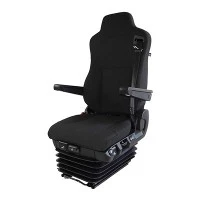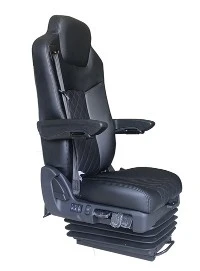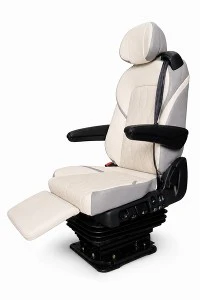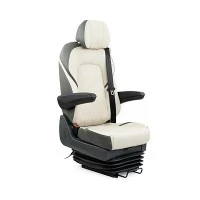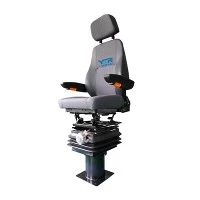


Walk into a locomotive cab for the first time and you might be surprised - it looks nothing like the driver's compartment of a car or truck. Controls are spread across multiple panels, displays wrap around the front, and at the center of it all sits a purpose-built Locomotive Cab Seat engineered to keep the operator comfortable, alert, and in full command of the machine. But where exactly is that seat positioned, and why does its location matter so much?
Left Side, Right Side, or Center? It Depends on the Country
The position of the driver's seat in a locomotive is not arbitrary - it follows the traffic rules of the country in which the railway operates. In left-hand traffic countries such as the United Kingdom, Japan, India, Australia, and South Africa, the driver sits on the left side of the cab. This placement gives the operator a clear, unobstructed view of the trackside signals and platform edges that appear to the left of the train.
In right-hand traffic countries - including the United States, Canada, most of continental Europe, China, and Russia - the driver's seat is located on the right side of the cab for the same reason: maximum visibility of the signals and infrastructure most relevant to safe operation.

|
Traffic Rule |
Typical Countries/Regions |
Driver's Seat Position |
Reason |
|
Left-hand traffic |
UK, Japan, India, Australia, South Africa |
Left side |
Signals and platforms on the left |
|
Right-hand traffic |
USA, Canada, Europe, China, Russia |
Right side |
Signals and infrastructure on the right |
|
Bi-directional / reversible |
High-speed trains, some freight locos |
Center or dual seats |
Operate in both directions without repositioning |
|
Light rail / tram |
Urban transit systems |
Center |
Equal visibility of road and trackside hazards |
|
Shunting locomotives |
Rail yards, freight depots |
Center or rotatable |
High demand for 360° visibility when coupling |
The key takeaway is that seat positioning is a safety decision first and foremost. A correctly placed driver has instant visual access to the signals, track edge, and platform that matter most - without straining, leaning, or guessing.
Why the Seat's Features Are Just as Important as Its Location
Knowing which side of the cab the driver sits on is only part of the story. The design of the seat itself plays an equally critical role in operational safety and long-term driver health. Today's professional locomotive seats are sophisticated ergonomic tools, not simple chairs bolted to a floor.
Consider the YSR911-41 from YSR Seating, a purpose-built seat designed specifically for railway cab environments. Its features work in direct coordination with the driver's position in the cab:
|
Feature |
Specification |
How It Supports Seat Position |
|
360° rotating base |
Lockable at any angle |
Access rear controls from any left/right/center position |
|
Vertical height adjustment |
60 mm range |
Sets eye level precisely at optimal sightline through cab windows |
|
Single-lock slide rail |
Forward/backward adjustable |
Fine-tunes distance from the control desk for any arm length |
|
Backrest recline |
121° total range (80° forward + 41° rear) |
Supports forward-leaning operation or resting posture on long shifts |
|
Heightened seat base |
Standard configuration |
Raises the driver's view above the control desk edge |

These are not luxury features - they are operational requirements. A poorly positioned driver with an inadequate seat reacts more slowly, tires more quickly, and is more prone to the kinds of micro-errors that can have significant consequences at speed.
Seat Placement Across Different Rail Systems Worldwide
The global railway industry has no single universal standard for driver positioning, which means manufacturers of Wholesale Locomotive Seat products must accommodate a wide range of cab configurations. Here is how seat placement and typical seating configuration vary by railway type worldwide:
|
Railway Type |
Typical Seat Position |
Typical Seat Configuration |
Examples |
|
Mainline freight/passenger (left-hand) |
Left side |
Fixed forward or bi-directional rotation |
UK Class 66, Japan EF series |
|
Mainline freight/passenger (right-hand) |
Right side |
Fixed forward or bi-directional rotation |
US GE Evolution, China HXD |
|
High-speed trains |
Center or dual control desk |
Center seat or twin driver desks |
Shinkansen, TGV |
|
Light rail / tram |
Center |
Center seat, often with standing support |
Most European tram systems |
|
Shunting locomotives |
Center or rotatable |
360° rotating seat with raised base |
US SW series, German V90 |
For railway operators procuring seats for a mixed fleet, working with experienced Locomotive Seat suppliers who understand these regional and functional differences is essential. A supplier who only stocks one configuration will struggle to meet the needs of a diverse rolling stock operation.
The Future of Locomotive Seat Design and Smart Procurement
The locomotive cab is evolving rapidly. Digitalization is bringing augmented reality (AR) displays into the cab, overlaying track data, signal states, and hazard alerts directly onto the driver's field of view. As these systems mature, the seat itself is expected to become an active part of the human-machine interface.
|
Future Trend |
Technical Feature |
Expected Benefit |
|
Memory settings |
Electric adjustment storing multiple driver profiles |
Faster shift handovers, no manual readjustment |
|
Biometric integration |
Heart rate and posture monitoring, auto-support adjustment |
Active fatigue prevention |
|
AR display sync |
Seat position linked to AR overlay calibration |
Critical info always in optimal sightline |
|
Active vibration isolation |
Electronic air or magneto-rheological suspension |
Further reduction of high-frequency vibration |
|
Lightweight materials |
Carbon fiber / aluminum alloy frames |
Lower vehicle weight, improved energy efficiency |

For procurement teams and fleet managers looking for a low price Locomotive Seat without compromising on these advancing capabilities, the answer lies in sourcing directly from manufacturers rather than through intermediaries. Factory-direct purchasing eliminates distributor markups and gives buyers direct access to engineering teams who can advise on the right configuration for their specific cab layout.
Railway operators with unique requirements - unusual cab dimensions, special climate or vibration conditions, or accessibility needs - should seek out Customized Locomotive Seat solutions. Customization at the manufacturing level produces a better fit at a lower total cost than attempting to modify off-the-shelf seats after purchase.
FAQ
Why do some train drivers sit on the left and others on the right?
It depends on the country's traffic rules. In left-hand traffic countries (UK, Japan, India), trackside signals are on the left, so drivers sit on the left for the best sightline. In right-hand traffic countries (US, China, Europe), drivers sit on the right for the same reason.
Do all locomotives have the driver's seat on one side only?
No. High-speed trains, metro systems, and some bi-directional locomotives use center seats or dual control desks, allowing operation in either direction without repositioning the driver.
What seat features are most important for train drivers?
360° rotation to access rear controls, height adjustment of 60 mm or more, a slide rail for desk distance, backrest recline for posture changes, and a raised base for improved visibility are the core requirements for safety and long-term operator health.
Can I get a custom seat for a unique cab layout?
Yes. Manufacturers like YSR Seating offer OEM/ODM customization to match specific cab dimensions, left or right placement requirements, and demanding operational environments.

Conclusion
The driver's seat in a locomotive is positioned on the left or right side of the cab depending on the traffic direction of the country in question, with center placement used in certain high-visibility applications like trams, shunters, and some high-speed trains. But location alone does not make a seat effective. The real value of a modern railway cab seat lies in its engineering: 360-degree rotation, multi-axis adjustability, ergonomic support, and the durability to withstand decades of demanding use.
Whether you are outfitting a new fleet, replacing aging cab furniture, or exploring the possibilities of customized ergonomic seating, choosing the right Locomotive Cab Seat suppliers is the decision that ties everything together. YSR Seating supplies purpose-built railway cab seats factory-direct, with no middlemen, OEM/ODM customization available, and a 12-month warranty on every unit.
Ready to find the right seat for your cab layout? Contact YSR Seating today for a quote or sample request.
Phone: +86-029-81136503
Email: sales@ysrseats.com
WhatsApp: +86-13991337062
WeChat: 18992819914
Related Articles
What is a locomotive cab seat?
Why do locomotive seats have suspension systems?
Do locomotive cab seats reduce fatigue and back pain?
What features do locomotive cab seats have?
Are locomotive seats adjustable for different drivers?
How are locomotive seats different from truck seats?
Do all locomotives have seats for drivers?
Where is the driver's seat located in a locomotive?
What is the standard size of a locomotive cab seat?