

When fleet managers and procurement teams set out to replace or specify seating for rail vehicles, one of the first practical questions they face is: what are the standard dimensions? Getting the size right is not simply a matter of comfort - it directly affects operator visibility, cab layout, emergency egress, and long-term ergonomic health. A seat that is too wide may interfere with the rotation clearance needed during shunting operations; one that is too tall may create blind spots for shorter operators; one that is too shallow may fail to provide adequate thigh support on long-haul routes. These are not minor inconveniences - in a safety-critical environment like a locomotive cab, poorly specified seating can contribute to operator fatigue, reduced reaction time, and in the worst cases, incidents on the line. Understanding the standard size of a Locomotive Cab Seat helps engineers and buyers ensure proper fit across an entire fleet, reduce installation errors, and meet railway authority requirements with confidence.
Standard Dimensions of the YSR911-41
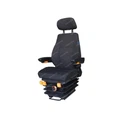
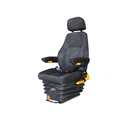
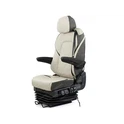
Among the most widely referenced models in the industry is the YSR911-41, a mechanical suspension seat designed for locomotives, high-speed trains, and subway vehicles. Its overall dimensions are 550 mm (L) × 1080 mm (H) × 500 mm (W), with a net weight of 33 kg and a gross weight of 36 kg. For shipping and storage, the packaged carton measures 580 mm × 580 mm × 680 mm - one seat per carton - making logistics straightforward for large orders.
These figures represent a practical industry benchmark. The 500 mm width keeps the seat compact enough for narrow locomotive cabs while still allowing the 360° rotating base to clear surrounding control consoles and cab walls. The 1080 mm total height accommodates the elevated base platform commonly used in rail vehicles to improve the driver's sightlines over the instrument panel and down the track ahead. The 550 mm seat length provides adequate thigh support without protruding into the cab aisle.

It is also worth noting what these dimensions mean in practice for installation teams. A 33 kg net weight means the seat can be handled by two technicians without lifting equipment in most cab environments, which reduces maintenance downtime during scheduled seat replacement or inspection. The standardized carton dimensions of 580 × 580 × 680 mm align well with standard freight pallet configurations, allowing multiple units to be stacked and transported efficiently - an important consideration when a single operator is outfitting dozens or hundreds of locomotives simultaneously. For buyers sourcing locomotive seats in volume, this combination of compact footprint, functional height, and logistics-friendly packaging has made the YSR911-41 a dependable reference point across multiple rail operators worldwide.
Adjustability - How the Working Size Adapts to Each Driver
Static dimensions only tell part of the story. A well-engineered rail seat must also accommodate the wide range of operators who will use it over its service life. The YSR911-41 offers 60 mm of vertical height adjustment, allowing the seat to be raised or lowered within the cab to suit drivers of different statures. The backrest provides a total recline range of 121° (80° backward plus 41° forward), effectively changing the functional depth of the seating position and reducing fatigue on long-haul routes. A single-lock slide rail allows fore-and-aft positioning so operators can reach controls comfortably regardless of leg length.
Beyond these primary adjustments, the mechanical suspension system built into the YSR911-41 plays a critical role in what operators actually experience during a shift. Railway environments expose drivers to continuous low-frequency vibration transmitted through the cab floor - a known contributor to whole-body vibration (WBV) disorders that can cause long-term spinal damage over years of daily exposure. The mechanical suspension seat absorbs and dampens these vibrations before they reach the operator, effectively reducing the health risk without requiring changes to the vehicle itself. This is a dimension of seat performance that static measurements alone cannot capture, but it is inseparable from the question of proper sizing: a suspension seat requires additional vertical travel space within the cab envelope, and the YSR911-41's overall height specification accounts for this travel.
This adjustability is particularly relevant for buyers seeking a low price Locomotive Seat that does not compromise on ergonomic range. Because a single model can be configured to fit a broad population of operators, fleets can standardize on one seat specification rather than stocking multiple variants - reducing procurement complexity and inventory costs simultaneously.
How Locomotive Seat Dimensions Compare to Other Vehicle Seats
It is worth understanding why locomotive seat dimensions differ from those found in trucks or buses. Long-haul truck seats typically run 520–550 mm wide and 1000–1100 mm tall, often equipped with air suspension systems but without any rotational capability. Bus driver seats are generally narrower at 480–520 mm and shorter at 950–1050 mm, prioritizing entry and exit speed over extended sitting posture.

Locomotive seats like the YSR911-41 sit in a distinct category: narrower than a truck seat to fit confined cab environments, taller than a bus seat to maximize track visibility, and uniquely equipped with 360° rotation to let the driver face different directions during shunting or reversing operations. The rotational function deserves particular attention from a sizing perspective. When a seat rotates through its full 360° arc, the effective swept footprint is determined by the seat's width and depth at their maximum points. A seat that measures 500 mm wide will require a clear rotation diameter of at least 550–580 mm in practice, accounting for the armrests and seat cushion edges. This means cab designers must plan for this swept zone when positioning control panels, side consoles, and access doorways - and it means that even a few millimeters of additional seat width can translate into significant cab layout constraints.
For buyers evaluating Wholesale Locomotive Seat options for a large fleet, understanding these distinctions is essential to avoid sourcing a seat designed for a different vehicle type that appears similar on a specification sheet but performs poorly in service.
Customization and Procurement Considerations
No two locomotive cab designs are identical. Older rolling stock may have tighter cab envelopes, while new high-speed platforms may impose different mounting bolt patterns, height restrictions, or materials standards tied to fire safety regulations. Subway and metro applications often require seats that meet specific flammability and smoke emission standards that differ from those applied to mainline freight locomotives. High-speed rail platforms may impose weight limits on cab fittings that require lighter seat frames without sacrificing structural integrity. All of these variables mean that a single off-the-shelf specification will not always be the right answer, even when it fits the majority of applications.
This is why access to Locomotive Cab Seat suppliers who offer genuine OEM and ODM customization is so important. YSR Seating, for example, can modify seat dimensions according to customer drawings before mass production begins, with sample units available for fit verification in the actual cab environment. Fabric choice, color, and surface material can also be specified without affecting the structural dimensions. This level of factory-direct flexibility is especially valuable for operators running specialized or legacy fleets where standard market offerings do not match the cab geometry inherited from older designs.
Material selection also plays a role that intersects with dimension. A seat specified with a thicker, high-density foam cushion may add 20–30 mm to the effective seat height compared to the base model - a seemingly small difference that can matter significantly when working within a cab envelope with tight headroom. Similarly, armrest configurations vary: fixed armrests add to the effective width of the seat in its installed state, while folding armrests reduce the clearance requirement and may be preferable in cabs where operators frequently move between the seat and standing control positions.

For procurement managers comparing Locomotive Seat suppliers, it is equally important to evaluate what is included in the base specification. Key questions include: does the standard height adjustment range cover your operator population? Is the 360° rotation base included, or an optional add-on? Does the supplier offer a warranty - YSR Seating provides a 12-month warranty on all seats - and can they support fleet-scale orders with consistent lead times? Buyers looking for Customized Locomotive Seat solutions should prioritize suppliers with in-house engineering capability, factory-direct pricing, and documented experience with railway certification requirements, as these factors reduce risk across the entire procurement cycle. A supplier who can provide certified test data for vibration damping performance, load ratings, and materials compliance will ultimately deliver far greater value than one competing solely on unit price.
Conclusion
While no single universal standard governs every locomotive cab seat across every railway system globally, the YSR911-41 provides a robust, well-established reference: 550 mm (L) × 1080 mm (H) × 500 mm (W), with 60 mm of vertical adjustability, a 121° backrest recline range, and a 360° rotating base. These dimensions reflect practical engineering decisions shaped by real cab constraints, operator ergonomics, vibration management requirements, and rail operating environments across decades of field experience. Whether you are outfitting a new fleet, replacing aging seats across existing rolling stock, or specifying seating for a specialized rail application, starting with a well-documented dimensional benchmark - and working with a supplier who can adapt it to your exact requirements - is the most reliable path to a successful procurement outcome.
Need a locomotive cab seat that fits your exact cab dimensions? Contact YSR Seating today for a quote, sample request, or OEM/ODM customization. With factory-direct prices, no middlemen, and a 12-month warranty, YSR Seating delivers seats sized precisely to your specifications.
Phone: +86-029-81136503
Email: sales@ysrseats.com
WhatsApp: +86-13991337062
WeChat: 18992819914
Related Articles
What is a locomotive cab seat?
Why do locomotive seats have suspension systems?
Do locomotive cab seats reduce fatigue and back pain?
What features do locomotive cab seats have?
Are locomotive seats adjustable for different drivers?
How are locomotive seats different from truck seats?
Do all locomotives have seats for drivers?
Where is the driver's seat located in a locomotive?
What is the standard size of a locomotive cab seat?