
In railway operations - from diesel locomotives and high-speed trains to urban subways - the physical environment of the operator directly shapes performance, safety, and long-term health. At the center of that environment is the driver's seat. A purpose-built Locomotive Cab Seat is far more than a place to sit: it is a precision-engineered workstation designed to absorb track vibration, support the spine across long shifts, and enable fast, confident access to every control in the cab. YSR Seating, a specialized source factory for railway driver seating, develops seats that meet these demands across a wide range of rolling stock applications. Understanding what goes into a high-quality locomotive seat - its construction, features, and operational impact - helps fleet operators, procurement teams, and OEM partners make smarter purchasing decisions.
What Exactly Is a Locomotive Cab Seat - and Why Does It Matter?
A locomotive cab seat is a specialized driver seat engineered specifically for rail vehicles. Unlike standard automotive or office seating, locomotive seats must contend with a uniquely harsh set of conditions: sustained whole-body vibration from the track, confined cab geometries that limit freedom of movement, multi-hour shifts without meaningful breaks, and the constant need to reach instruments, radios, and emergency controls positioned throughout the cab. Meeting these requirements calls for construction that goes well beyond conventional seating.
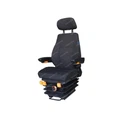
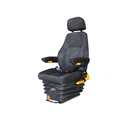
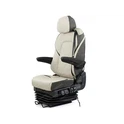
The key differentiators are mechanical suspension (to isolate the operator from track-induced shock and vibration), a raised seat base (to improve sightlines over the console and out of the cab windows), a single-lock slide rail for quick fore-aft positioning, and a full 360° rotating base that allows the operator to swivel toward any section of the cab without leaving the seat. Together, these features transform a passive piece of furniture into an active ergonomic tool that works with the operator rather than against them.

Technical Specifications and Core Ergonomic Features
YSR Seating's reference model, the YSR911-41, illustrates the level of engineering precision that distinguishes professional railway seating from general-purpose alternatives. The seat offers a vertical adjustment range of 60 mm, allowing operators of different statures to position themselves so their feet rest naturally on the pedals and their eyes align with the cab instruments - a critical factor for both comfort and reaction speed. Backrest adjustment spans 80° of recline combined with a 41° forward tilt, giving operators the flexibility to shift posture during long runs and reduce cumulative stress on the lumbar spine. The unit ships individually (MOQ: 1 pc), arrives with full packaging protection, and carries a 12-month warranty. OEM and ODM customization - including seat height, upholstery fabric, and color - is available for operators building to specific fleet standards.
The mechanical suspension system is arguably the most important single feature for operator health. Railway cabs transmit vibration in multiple axes simultaneously, and sustained exposure - particularly in the 4–8 Hz range that aligns with the resonant frequency of the human spine - is a documented cause of back injury in train operators. The YSR911-41's suspension dampens these inputs before they reach the operator, reducing fatigue accumulation over a shift and lowering the risk of long-term musculoskeletal injury. The heightened base raises the operator's eye level to improve forward visibility, while the ergonomic backrest profile follows the natural curvature of the lumbar and thoracic spine to distribute load evenly rather than concentrating pressure at a single point.
Operational Advantages: Productivity, Safety, and the Value of 360° Rotation
The practical benefits of a well-specified locomotive seat extend across three dimensions: operator wellbeing, daily productivity, and active safety. On the wellbeing side, preventing fatigue is not simply a comfort objective - fatigue is a primary contributor to human error in rail incidents. A seat that supports natural posture and absorbs vibration keeps operators physically fresh and mentally alert throughout their duty window. For fleet managers sourcing low price Locomotive Seat options at volume, this translates directly into reduced sick days, lower workers' compensation claims, and longer careers for experienced drivers - all measurable returns on the seating investment.
Productivity improvements follow naturally from comfort: an operator who is not fighting back pain or compensating for poor visibility can concentrate fully on the route, the instruments, and the timetable. Emergency responsiveness is also directly tied to seat geometry - operators who can reach the brake handle, the communication system, and secondary controls without awkward stretching or repositioning respond faster and more reliably when seconds matter.

Full 360° rotation deserves particular attention because it addresses a problem unique to railway cabs: controls and sightlines that are distributed across a wide arc. Unlike a road vehicle, where almost everything faces forward, a locomotive cab may require the operator to monitor displays to the side or rear, communicate with a conductor at the cab door, or inspect instruments mounted behind the primary driving position. A non-rotating seat forces the operator to twist the torso repeatedly - a posture that accelerates fatigue and strains the spine. A fully rotating base eliminates that constraint, allowing smooth, natural reorientation to any part of the cab without leaving the seat or compromising the operator's readiness to return to the driving position instantly.
Sourcing the Right Seat: Buying Tips for Fleet Operators and OEM Partners
For operators evaluating Wholesale Locomotive Seat procurement - whether outfitting a new fleet, retrofitting existing rolling stock, or standardizing across a mixed roster of vehicle types - several criteria should anchor the selection process. First, verify that the seat's suspension specification matches the vibration profile of the vehicles in question; a seat tuned for a slow freight locomotive may not provide adequate damping for a high-speed intercity unit. Second, confirm the range of ergonomic adjustability: operators vary significantly in height and build, and a seat that cannot accommodate the full crew population will create problems regardless of its other qualities.
When comparing Locomotive Seat suppliers, give weight to factories that offer genuine OEM and ODM customization rather than superficial color changes. Rail operators often have specific requirements driven by cab geometry, fleet-wide color standards, or seat-rail interface dimensions that differ from a supplier's standard configuration. A factory that can accommodate these requirements - adjusting the base mount pattern, modifying the slide-rail length, or sourcing alternative upholstery fabrics - delivers far more long-term value than one offering fixed catalog items. YSR Seating operates as a source factory with full in-house customization capability, supporting both small trial orders (MOQ: 1 pc) and high-volume production runs with consistent quality.
Looking ahead, the next generation of Customized Locomotive Seat solutions is beginning to incorporate augmented reality compatibility - seat geometries and sight-line profiles designed to work with head-up display systems and AR-assisted navigation tools that are entering service on advanced rail platforms. YSR Seating is actively developing seat architectures that anticipate these requirements, ensuring that operators who invest in current-generation products are not locked out of future technology upgrades.

Conclusion
A locomotive cab seat is not a peripheral accessory - it is one of the most operationally significant components in the cab. Chosen correctly, it prevents injury, sustains alertness, accelerates emergency response, and accommodates the full diversity of operators who will occupy it across the vehicle's service life. Chosen poorly, it becomes a steady source of fatigue, complaint, and liability. Whether you are a transit authority standardizing across hundreds of units, a fleet manager retrofitting older rolling stock, or an OEM designing a new cab from the ground up, the seat specification deserves the same rigor applied to traction systems and braking hardware.
As a dedicated source factory and one of the leading Locomotive Cab Seat suppliers in the market, YSR Seating offers factory-direct pricing, full OEM/ODM customization, and a 12-month warranty across its locomotive seating range. Ready to upgrade your cab seating? Contact YSR Seating today for a quote or sample request:
Phone: +86-029-81136503
Email: sales@ysrseats.com
WhatsApp: +86-13991337062
WeChat: 18992819914
Related Articles
What is a locomotive cab seat?
Why do locomotive seats have suspension systems?