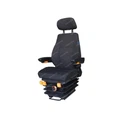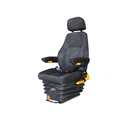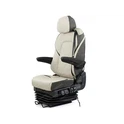


When it comes to heavy-duty industrial seating, not all seats are created equal. A Locomotive Cab Seat like the YSR911-41 from YSR Seating is a precision-engineered product designed specifically for the rigors of rail operations - and it differs fundamentally from a tractor seat in ways that directly affect operator safety, comfort, and productivity. While both types of seats must support operators through long, demanding shifts, the environments they operate in are so different that the engineering solutions behind each are worlds apart. Understanding these differences is essential for fleet managers, procurement teams, and OEM manufacturers looking to make the right seating investment.
Rotation, Visibility, and Cab Access
One of the most immediately noticeable differences between locomotive seats and tractor seats is rotation capability. A locomotive cab seat like the YSR911-41 features a full 360° rotating base as a standard specification. This is not a luxury - it is a functional necessity. Locomotive cabs are equipped with control panels and instrumentation on multiple sides, including rear-facing consoles. A driver must be able to access these controls fluidly without twisting or straining the spine during a multi-hour shift. The heightened seat base further supports this, raising the operator's eye level to maintain a clear line of sight to forward tracks, signals, and overhead infrastructure.
Tractor seats, by contrast, are almost always fixed-facing or offer only a very limited swivel range of around 15 to 30 degrees. Since agricultural machinery is operated with implements mounted in front or behind the vehicle, the operator rarely needs to turn. Full rotation in a tractor seat could even introduce safety risks in an open-cab or semi-open field environment. For buyers exploring a low price Locomotive Seat option, it is worth noting that the 360° rotation feature is standard across YSR's locomotive range - not a costly upgrade.

Suspension Design and Environmental Durability
The suspension systems in locomotive and tractor seats are tuned for entirely different vibration profiles. Rail travel produces high-frequency, continuous vibrations as the train passes over rail joints and track irregularities. The YSR911-41 uses a mechanical suspension system calibrated to dampen these constant, low-amplitude vibrations, protecting the spine from cumulative fatigue over long journeys. The vertical adjustment range of 60 mm and 121° total backrest recline (80° + 41°) further accommodates different operator body types and driving postures over extended periods.
Tractor seats face the opposite challenge: low-frequency, high-amplitude shocks from potholes, uneven soil, and sudden terrain changes. As a result, they typically use either mechanical or air suspension with greater vertical travel - often 80 to 120 mm - to absorb those hard, sudden impacts. Environmental durability is another major divergence. Tractor seats are exposed to mud, moisture, UV radiation, agricultural chemicals, and dramatic temperature swings. Their upholstery is typically heavy-duty vinyl or other non-porous materials that can be hosed down and wiped clean easily. Wholesale Locomotive Seat buyers, on the other hand, will find that locomotive seats prioritize long-shift breathability, using composite knitted fabrics and leather options suited to the enclosed, climate-controlled environment of a modern locomotive cab.
Customization, Adjustment, and Procurement
For procurement teams and OEM manufacturers, another important distinction lies in customization depth. Locomotive Seat suppliers like YSR Seating offer full OEM and ODM support, meaning seat dimensions, colors, fabrics, and mechanical configurations can all be adapted to specific train models or operator requirements. The YSR911-41, for example, features a single-lock slide rail - a design choice that prioritizes secure, vibration-resistant positioning on a moving train. Tractor seat slide rails more commonly use dual-lock systems optimized for the slower pace of field work and the need for quick repositioning.

For companies looking for a Customized Locomotive Seat to match a specific locomotive cab design or operator ergonomic standard, factory-direct manufacturers offer significant advantages: shorter lead times, precise specification matching, and no intermediary markups. Tractor seat customization is generally more limited, focused on fabric or vinyl material choices, with less flexibility in base geometry or mechanical systems. Buyers working with Customized Locomotive Seat requirements should look for suppliers that provide detailed technical sheets and prototype validation before bulk orders.
Why the Right Seat Matters for Safety and Productivity
The differences between locomotive and tractor seats are not merely technical specifications - they have direct consequences for operator health and operational efficiency. Fitting a locomotive cab with a seat designed for agricultural use, or vice versa, can result in inadequate vibration damping, poor postural support, and restricted access to essential controls. Over time, this increases the risk of musculoskeletal disorders, reduces alertness, and may even compromise emergency response capability. The 360° rotation available on dedicated locomotive seats is a safety feature as much as an ergonomic one - enabling rapid access to rear controls in time-critical situations without the operator leaving their seat.
For buyers evaluating Locomotive Cab Seat suppliers, the key factors to assess are: suspension tuning (matched to rail vibration frequency), rotation capability, seat base height, and the availability of OEM customization. Tractor seat suppliers optimize for entirely different criteria - terrain shock absorption, weatherproofing, and field-ready durability. Matching the seat to the environment is fundamental to getting the most out of any industrial seating investment.

Conclusion
Locomotive seats and tractor seats are purpose-built for two very different worlds. From the full 360° rotation and heightened base of a dedicated Locomotive Cab Seat, to the rugged vinyl upholstery and high-amplitude suspension of agricultural seating, every design decision reflects the unique demands of each operating environment. Choosing the correct seat type - and sourcing it from a specialist manufacturer - is one of the most impactful decisions a fleet operator or procurement manager can make for long-term operator health and safety.
If you are looking for a factory-direct partner for locomotive or industrial seating - whether you need a standard model, a low price Locomotive Seat for a large fleet, or a fully customized solution - YSR Seating is ready to help. Contact us today for expert guidance, OEM/ODM consultation, and competitive wholesale pricing.
Phone: +86-029-81136503
Email: sales@ysrseats.com
WhatsApp: +86-13991337062
WeChat: 18992819914
Related Articles
How are locomotive seats different from tractor seats?
What is the specification of a locomotive cab seat?
How is Locomotive Cab Seat different from a regular train passenger seat?
Is Locomotive Cab Seat only used in trains?
What adjustments does Locomotive Cab Seat have?
What types of locomotives use Locomotive Cab Seats?