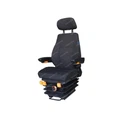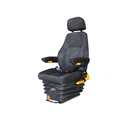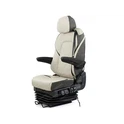


Locomotive operators spend anywhere from 8 to 12 hours at the controls per shift, meaning a seat is far more than a place to sit - it is a critical piece of safety and productivity equipment. A well-engineered Locomotive Cab Seat must accommodate drivers of different statures, support healthy posture over long journeys, and allow instant access to controls in every direction. Modern designs meet these demands through a comprehensive set of mechanical adjustments that can be fine-tuned to each individual operator. One standout example is the YSR911-41 from YSR Seating, a mechanical suspension seat purpose-built for locomotives, high-speed trains, and subway systems. In this guide, we break down every major adjustment these seats offer and explain why each one matters for the people who rely on them every day.
Key Adjustments Available on Modern Locomotive Seats
1. Vertical Height Adjustment
The standard vertical height adjustment range on the YSR911-41 is 60 mm, and it can be extended further through OEM customization. This adjustment ensures that drivers of different heights can position themselves so their feet rest flat on the floor and their line of sight clears all signal indicators and track hazards ahead. Poor seat height forces operators to adopt unnatural postures that cause leg fatigue and reduce reaction speed - both serious concerns on long-distance runs. Among all locomotive seats on the market, vertical height adjustment is considered a baseline requirement rather than a premium feature, yet the range and precision of that adjustment vary considerably between suppliers.
2. Backrest Recline Adjustment
The YSR911-41 offers a total recline range of 121 degrees - 80 degrees forward and 41 degrees backward. This wide range allows operators to adopt an upright, alert posture during active control periods and shift to a more relaxed reclined position during rest breaks without leaving the seat. Sustained upright posture without any recline option is a significant contributor to lower back strain over multi-hour shifts. A seat that can flex between working and resting positions is therefore not just a comfort feature but a genuine injury-prevention measure. Buyers looking for a low price Locomotive Seat should verify that backrest recline range is not compromised in budget models, as it is one of the adjustments most directly linked to long-term operator health.

3. Fore-Aft Slide and 360° Rotation
The fore-aft slide rail - a single-lock mechanism on the YSR911-41 - allows operators to adjust their distance from the control desk and floor pedals. A few centimeters of forward or backward movement can make the difference between a comfortable, controlled reach and an awkward, fatiguing stretch repeated hundreds of times per shift. Complementing this is the seat's full 360-degree rotation capability, which is standard on the YSR911-41. This swivel function allows operators to access rear-facing controls, communicate with crew, or respond to emergencies without twisting the torso, which over time can cause serious spinal stress. Those sourcing a Wholesale Locomotive Seat for a fleet should confirm that both the slide rail lock mechanism and the rotation bearing are rated for the frequency of use typical in commercial rail operations.
4. Lumbar Support and Ergonomic Contour
The lumbar support on the YSR911-41 is integrated directly into the seat back rather than offered as a bolt-on accessory. While it is not independently adjustable in terms of protrusion depth, it is designed to conform to the natural curve of the spine and maintain that alignment throughout a full shift. This approach reduces the cumulative fatigue and injury risk associated with unsupported seated posture. Reputable Locomotive Cab Seat suppliers invest in ergonomic research when designing lumbar support systems precisely because back injuries are among the most common and costly occupational health issues in the rail industry. A seat with well-designed integrated lumbar support often outperforms one with a poorly engineered adjustable lumbar system.
Adjustment Summary: YSR911-41 at a Glance
|
Adjustment |
Range / Feature |
Key Benefit |
|
Vertical Height |
60 mm (customizable) |
Proper pedal reach, improved visibility |
|
Backrest Recline |
80° + 41° = 121° total |
Working and resting posture flexibility |
|
Fore-Aft Slide |
Single-lock rail |
Optimal distance to controls and pedals |
|
360° Rotation |
Full rotation (standard) |
Access rear controls, reduced torso strain |
|
Lumbar Support |
Integrated ergonomic contour |
Spine alignment, reduced injury risk |
|
Height / Color / Fabric |
Fully customizable (OEM/ODM) |
Fleet-specific and cab-specific fitting |

Customization Options and OEM/ODM Capabilities
Beyond the standard mechanical adjustments, a key advantage of working with dedicated Locomotive Seat suppliers like YSR Seating is the ability to specify custom configurations from the ground up. The vertical height range can be extended beyond the standard 60 mm to accommodate rail networks where driver height distributions differ significantly from global averages. Fabric type and color can be matched to existing cab interior specifications, which matters both aesthetically and practically - certain fabric grades offer superior flame resistance, moisture wicking, or durability ratings relevant to specific operating environments.
YSR supports full OEM and ODM manufacturing, meaning operators and procurement teams can submit their own drawings and receive a Customized Locomotive Seat built precisely to those specifications. Sample production is available before committing to bulk orders, which is particularly valuable for transit authorities and rolling stock manufacturers evaluating multiple seating options during fleet procurement. With a minimum order quantity of just one piece and a 12-month warranty, the barrier to trialing a custom configuration is deliberately low.

Conclusion
A modern Locomotive Cab Seat is a precision ergonomic instrument, not just a piece of furniture. The adjustments available on seats like the YSR911-41 - 60 mm vertical height, 121-degree backrest recline, fore-aft slide, full 360-degree rotation, integrated lumbar support, and extensive customization options - directly translate into safer, more comfortable, and more productive operations. Each adjustment addresses a real physiological need arising from the demands of long-duration, high-attention rail work.
Need a seat built around your drivers' exact requirements? YSR Seating offers Wholesale Locomotive Seat pricing with no middlemen, ex-factory rates, MOQ of 1 piece, and a 12-month warranty. Contact us today for a quote or sample request.
Contact YSR Seating
Phone: +86-029-81136503
Email: sales@ysrseats.com
WhatsApp: +86-13991337062
WeChat: 18992819914
Related Articles
How are locomotive seats different from tractor seats?
What is the specification of a locomotive cab seat?
How is Locomotive Cab Seat different from a regular train passenger seat?
Is Locomotive Cab Seat only used in trains?
What adjustments does Locomotive Cab Seat have?
What types of locomotives use Locomotive Cab Seats?