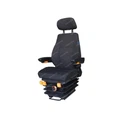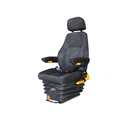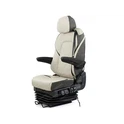


When people think about train seating, they often picture rows of cushioned passenger seats lining a carriage - a familiar sight for commuters and long-distance travelers alike. But deep in the front cab, away from the passenger carriages and platform announcements, a completely different kind of seat does a very different job. A Locomotive Cab Seat is a precision-engineered workstation built for the driver - and comparing it to a regular passenger seat reveals just how far apart the two truly are in design, function, material quality, and long-term performance. Understanding these differences is essential not only for railway procurement teams but also for anyone involved in fleet safety, driver health management, or rolling stock specification.
Built for Two Very Different Purposes
A regular train passenger seat is designed around one simple goal: keeping a traveler reasonably comfortable for the duration of a journey. It typically offers a fixed orientation, basic foam padding, perhaps a small recline angle, a fold-down tray table, and little else. The design philosophy is straightforward - maximize the number of seats in a given space, keep maintenance costs low, and ensure the seat survives years of high-turnover use by members of the general public. There is no need for advanced adjustability because passengers are not operating machinery. They are simply sitting still, reading, sleeping, or looking out the window, and they will vacate the seat within hours.
Locomotive seats, by contrast, must serve as a full ergonomic workstation for a trained professional who may spend an entire working shift - and a career spanning decades - in that single position. Take the YSR911-41 from YSR Seating as a prime example. This seat features a 360° rotating base, mechanical suspension, a single-lock slide rail, and a heightened base for improved operational visibility. Its backrest reclines up to 121° (combining an 80° and 41° adjustment range), and vertical height adjustment spans 60 mm. The seat dimensions are 550 × 1080 × 500 mm, and it weighs 33 kg - a figure that reflects the reinforced steel construction and heavy-duty components required to handle the physical demands of daily professional use across diesel locomotives, high-speed trains, and subway systems. None of these features exist in standard passenger seating, because passengers simply do not need them, and including them would add unnecessary weight, cost, and complexity to rolling stock that prioritizes capacity over operator ergonomics.

The Critical Differences: Rotation, Suspension, and Adjustability
Three technical differences stand out most clearly when comparing driver seating with passenger seating, and each one has a direct, measurable impact on operational safety and driver wellbeing.
- Rotation is the first and most immediately visible difference. A locomotive driver must access rear-facing controls, communicate with crew members positioned behind them, check signals from multiple angles, and respond quickly to changing track conditions. The 360° swivel base on professional locomotive seats makes this possible without the driver ever having to strain their back, twist their neck, or compromise their posture. In emergency situations, this rotational freedom can be the difference between a fast, correct response and a delayed, physically awkward one. A passenger seat, fixed firmly forward - or backward on some reversible routes - would make these operational tasks dangerous or outright impossible.
- Suspension is the second critical difference, and arguably the most important from a long-term health perspective. Drivers operate locomotives for 8 to 12 hours per shift, every working day, exposed to continuous vibrations transmitted through the rail bed, the wheels, and the chassis of the locomotive itself. Without mechanical suspension built into the seat structure, these vibrations travel directly into the driver's spine, hips, and lower back with every meter of track covered. Over months and years, the cumulative effect is serious: chronic lower back pain, intervertebral disc degeneration, and musculoskeletal disorders that can end careers and generate significant occupational health liability for rail operators. This is precisely why businesses searching for a low price Locomotive Seat that still meets professional standards should pay very close attention to suspension quality - cutting costs here directly impacts driver health and long-term safety outcomes in ways that far outweigh the initial savings. Regular passenger seats carry no suspension at all, which is entirely appropriate given that travelers are not exposed to the same sustained, occupationally cumulative vibration loads that professional drivers face.
- Adjustability is the third major differentiator. A driver must position themselves with precision relative to cab controls, instrument panels, forward windows, and mirrors - and because human bodies vary significantly in height, reach, and proportional dimensions, a fixed seat simply cannot accommodate all operators safely and comfortably. A Wholesale Locomotive Seat built to professional standards will offer multi-directional adjustment as standard: vertical height adjustment, fore-aft slide on a single-lock rail, backrest recline across a wide angular range, and integrated lumbar support contoured to support the natural curve of the spine during long shifts. These adjustments are not comfort extras - they are occupational health requirements. Passenger seats, by design, follow a one-size-fits-most philosophy, offering minimal or no adjustability beyond a limited recline, because the cost and complexity of full ergonomic adjustment cannot be justified across hundreds of seats per train set.
Visibility, Base Height, and the Operational Environment
One feature of professional driver seating that receives less attention than suspension or rotation - but is equally important in practice - is the heightened seat base. In a locomotive cab, the driver must maintain clear sightlines to the track ahead, to trackside signals, to overhead electrification systems, and to platform edges during station stops. A standard-height seat would position many drivers too low for reliable, comfortable visibility across all these reference points, particularly over the course of a long shift when fatigue begins to affect posture.
The elevated base built into professional locomotive cab seats raises the driver's eye level to the correct operational height for their cab configuration, ensuring that visibility remains consistent and unobstructed regardless of driver height or posture changes over time. Passenger seats, designed purely around window-viewing comfort at standard carriage height, have no such requirement and no such feature.

Durability, Certification, and Operational Impact
Beyond the mechanical and ergonomic differences, locomotive driver seats are held to a significantly higher standard of durability and formal certification than regular passenger seating. The YSR911-41 carries ISO9001 certification - a quality management benchmark that confirms manufacturing consistency, material traceability, and process control at every stage of production. This level of certification assures railway procurement teams that each unit leaving the factory meets the same specification as the last, a critical assurance when seating is being installed across an entire fleet.
This distinction matters enormously when sourcing from Locomotive Cab Seat suppliers. Reputable suppliers provide full documentation, traceable quality control records, and warranty coverage - 12 months in the case of YSR Seating - that reflects the professional-grade nature of the product and the serious operational consequences of a seat failure in service. Procurement teams evaluating Locomotive Seat suppliers should look well beyond unit price, and verify certifications, warranty terms, after-sales support capacity, and the availability of custom configurations before committing to a supply relationship.
Passenger seats typically meet fire-safety and flame-retardancy standards appropriate for public passenger environments, but they are not subject to the same rigorous quality management frameworks applied to operator seating, because the consequences of a passenger seat failure - while commercially and reputationally significant - do not carry the same immediate operational safety implications as a failure in the driver's cab.
Customization: A Key Advantage of Professional Driver Seating
One of the most practically significant advantages of working with dedicated Customized Locomotive Seat manufacturers is the ability to adapt seating to the specific requirements of different cab designs, operational environments, and workforce demographics. Rail fleets are not uniform - a high-speed intercity operator, a suburban metro system, and a freight locomotive provider all have different cab configurations, different duty cycles, different climate conditions, and different driver populations. A seat designed for one environment may be entirely unsuitable for another.
Working with manufacturers who offer genuine OEM and ODM customization allows operators to specify seat dimensions, suspension travel ratings, upholstery materials suited to specific temperature ranges, base configurations compatible with their cab floor layouts, and armrest or control-panel integration options. This level of flexibility is a normal and expected part of the professional driver seating supply chain. No equivalent customization infrastructure exists for standard passenger seating, which is produced in very high volumes with minimal variation and no expectation of cab-specific engineering input.
Why Choosing the Right Driver Seat Matters
The differences between a locomotive cab seat and a passenger seat are not cosmetic, incidental, or a matter of simple preference - they are functional, occupational, and safety-critical at every level. Using an unsuitable seat in a locomotive cab creates a chain of negative consequences: driver fatigue sets in earlier, reaction times slow, physical injury risk increases, sick leave and occupational health claims rise, and the long-term cost to the operator far exceeds whatever was saved on the initial seat purchase.
The 360° rotation, mechanical suspension, multi-directional adjustability, heightened base, and reinforced construction found in professional driver seats are not premium extras. They are engineering necessities that directly enable safe, effective, and sustainable locomotive operation across demanding duty cycles and long careers.
As rail technology continues to evolve, the gap between driver seating and passenger seating will only widen further. Emerging integrations - such as augmented reality (AR) displays built into cab environments to enhance forward visibility, signal recognition, and navigation - will place even greater demands on the driver's seating position, requiring adjustable, stable, ergonomically optimized platforms that can accommodate new hardware and interface systems without compromising driver comfort or operational effectiveness.

Conclusion
If you are managing a railway fleet and need to upgrade your locomotive cabs with professional driver seats, YSR Seating offers factory-direct pricing with no middlemen, a minimum order quantity of just one piece, 12-month warranty coverage, and full OEM/ODM customization support tailored to your specific fleet requirements. Whether you are sourcing a single replacement seat or specifying seating across an entire network, the team at YSR Seating can provide samples, technical specifications, and competitive quotes designed to meet your operational needs without compromise.
Contact YSR Seating today:
Phone: +86-029-81136503
Email: sales@ysrseats.com
WhatsApp: +86-13991337062
WeChat: 18992819914
Related Articles
How are locomotive seats different from tractor seats?
What is the specification of a locomotive cab seat?
How is Locomotive Cab Seat different from a regular train passenger seat?
Is Locomotive Cab Seat only used in trains?
What adjustments does Locomotive Cab Seat have?
What types of locomotives use Locomotive Cab Seats?