

When investing in a Semi Truck Luxury Air Suspension Seats system, most drivers focus on visible features-heating, massage functions, lumbar support-while overlooking one of the most technically critical specifications: the weight range the seat is engineered to support. This single parameter determines whether the suspension system will actually perform as intended, or simply fail to deliver the comfort and protection it promises. Understanding weight range compatibility is not optional; it is the foundation of getting real value from a premium seating investment.
The Standard Weight Range and Why It Matters
Premium air suspension truck seats are typically engineered to support an automatic weight adjustment range of 40kg to 130kg. Using the YSR6000 series as a benchmark, this specification covers the vast majority of adult drivers-from lighter individuals to heavier operators-making it practical for both owner-operators and large fleet deployments.
This broad range exists for a specific engineering reason. An air suspension seat does not operate like a static foam cushion. The air spring inside the seat must be pressurized to precisely the right level for the occupant's weight. When the pressure is correctly calibrated, the spring absorbs road vibrations and shocks before they travel up through the driver's spine. When it is not, the entire system fails at its primary job-regardless of how advanced the other features are.

For fleet managers evaluating options from semi truck luxury air suspension seats suppliers, this specification deserves as much attention as visible comfort features. A seat with a wide, accurately calibrated weight range ensures consistent performance across diverse driver populations without requiring intervention or manual adjustment between shifts.
How Automatic Weight Adjustment Works
The mechanism behind automatic weight adjustment is what separates modern air suspension seats from older mechanical designs. When a driver sits down, sensors within the system detect the occupant's weight and automatically regulate air pressure within the spring to achieve the correct ride height and suspension stiffness. The process takes seconds and requires no input from the driver.
This is a meaningful improvement over manual pre-load systems, where drivers were required to adjust a dial or lever to set the suspension tension themselves. In practice, manual adjustment was frequently skipped, done incorrectly, or simply forgotten-resulting in a seat operating outside its optimal parameters for the entire shift. A driver weighing 90kg riding a seat set for 60kg experiences a suspension that is far too stiff, transmitting vibrations rather than absorbing them. The reverse scenario-a lighter driver on a setting tuned for a heavier occupant-produces a seat that compresses too easily and bottoms out on rough roads.
Automatic adjustment eliminates this problem entirely. For companies looking to Buy Luxury Air Suspension Seat solutions for multi-driver vehicles, this feature is not a luxury-it is a practical necessity that protects both driver health and the seat's mechanical longevity.
What Happens Outside the Supported Weight Range
Understanding the limits of the 40kg–130kg range is equally important. When an occupant falls outside this engineered range, the seat cannot compensate through automatic adjustment, and performance degrades in predictable ways.
For drivers under 40kg, the air spring cannot reduce pressure sufficiently to achieve optimal softness. The seat behaves too stiffly, transmitting road vibrations directly rather than isolating them. Fatigue accumulates faster, and the ergonomic benefits of the suspension system are largely lost.
For drivers over 130kg, the opposite problem occurs. The air spring lacks the pressure capacity to fully support the occupant's weight under dynamic loading conditions. On rough terrain or during sudden impacts, the seat may bottom out-meaning the suspension collapses to its mechanical stop, delivering a sharp shock directly to the driver's spine. Repeated bottoming-out also accelerates wear on internal components, shortening the seat's service life.
The solution for drivers outside the standard range is customization. Reputable Luxury Air Suspension Seat suppliers can offer alternative air spring configurations or modified suspension tuning to accommodate specific driver demographics. Fleet operators with non-standard requirements should explore Customized semi truck luxury air suspension seats options directly with manufacturers, ensuring that the final specification matches the actual driver population rather than a generic average.
Complementary Features That Work With Weight Calibration
Once weight calibration is correctly established, the seat's other adjustment systems layer on top to deliver a fully personalized ergonomic experience. These features operate independently of weight range but depend on the suspension being correctly tuned to function as intended.
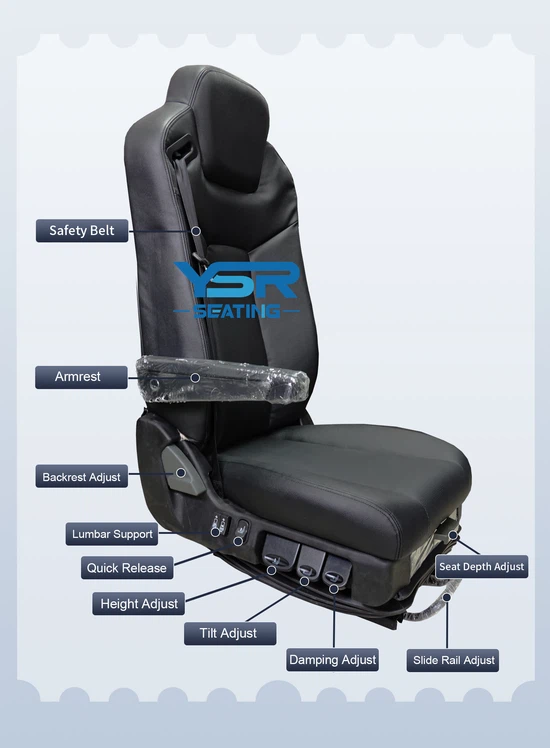
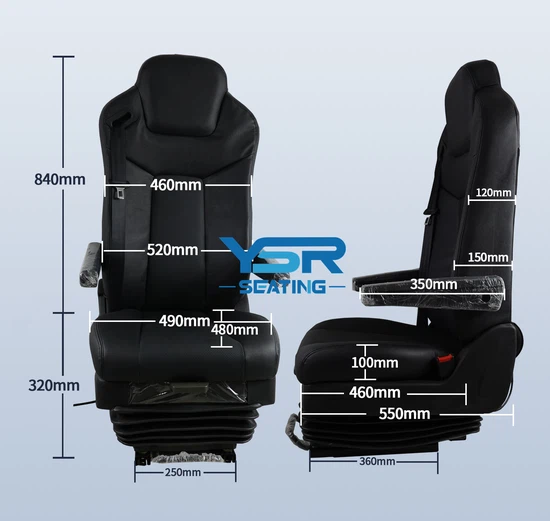
Integrated dual-airbag lumbar support allows drivers to adjust the depth and firmness of lower back support to match their individual spinal curvature. Height adjustment of ±65mm and seat tilt of ±14° enable proper pelvic positioning-the anatomical foundation of healthy seated posture. A 60mm seat depth adjustment accommodates varying leg lengths, while a 121° backrest recline range allows the driver to shift posture during long hauls, reducing static load on the spine.
Premium models extend further into active comfort territory. Seat heating addresses muscle stiffness during cold-weather operations, while integrated massage functions provide periodic stimulation to reduce the circulation problems associated with extended stationary driving. These features enhance fatigue reduction but cannot compensate for a suspension system operating at the wrong weight calibration-which is why getting the weight range right comes first.
For those working with China Luxury Air Suspension Seats suppliers, it is worth confirming that the full suite of complementary features is integrated with the same engineering precision as the suspension system itself. A well-built seat functions as a unified system, not a collection of independent add-ons.

Making the Right Choice for Individual Drivers and Fleets
For an individual driver, the path to the right seat starts with verifying that your body weight falls comfortably within the seat's supported range-ideally not at the extreme edges, where the system has less margin to respond to dynamic loading. From there, selecting a model with automatic weight adjustment removes the ongoing burden of manual calibration and ensures the seat performs correctly every time you sit down.
For fleet operators, the calculus is more complex. Mixed driver populations require a seat with a broad, reliable weight range and robust automatic adjustment. Manual calibration systems in fleet settings almost always result in improper use, negating the investment in premium suspension technology. Requesting an Air Suspension Seats quotation that specifies automatic weight adjustment range, damping control options, and available customization paths allows procurement teams to make technically informed decisions rather than selecting on price or appearance alone.
The bottom line is straightforward: an air suspension seat that is not properly matched to the driver's weight cannot deliver vibration isolation, ergonomic support, or fatigue reduction-regardless of its price point or feature list. Weight range is not a footnote in the specification sheet. It is the core variable that determines whether the seat works. Ensuring compatibility, exploring customization where needed, and choosing suppliers who engineer automatic calibration with precision are the steps that turn a premium seat into a genuine long-term investment in driver health and operational performance.
For inquiries about product specifications, customization options, or fleet quotations, contact the team directly at 📧sales@ysrseats.com, 📞+86-029-81136503, or via WhatsApp at +86-13991337062.
Related Articles
What makes a truck seat "luxury" or premium?
Do air suspension truck seats reduce back pain?
How do you adjust a semi-truck air ride seat correctly?
What is the difference between air suspension and mechanical suspension seats?
Will an air suspension seat fit my truck?
Are luxury air ride seats worth the price?
What weight range can air suspension truck seats support?
How long do semi-truck air suspension seats last?