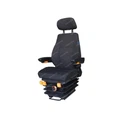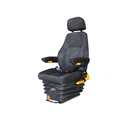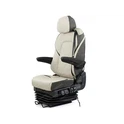


Why do seemingly ordinary seats for construction machinery (such as those in excavators, loaders, and cranes) often cost anywhere from $500–$600 to over $1,000-far exceeding the price of standard home office chairs or even some car seats?
This is because these seats involve significant technical barriers and high manufacturing costs regarding safety standards, adaptability to harsh environments, vibration and noise reduction technologies, and ergonomic design.

1. Core Cost
Active and Passive Suspension Systems. Operators work for 8–12 hours a day amidst violent jolts, high-frequency vibrations, and complex terrain. Without an efficient suspension system, Whole-Body Vibration (WBV) can lead to serious occupational ailments, such as spinal disorders and lumbar disc herniation.
Air Suspension: High-end construction machinery seats typically feature built-in air bladders and electronic control units (ECUs). These systems automatically adjust air pressure based on the operator's weight to dynamically counteract low-frequency, high-amplitude jolts.
Mechanical-Hydraulic Damping: Designed for mid-to-low-end models or specific operating conditions, these seats integrate complex systems of high-strength springs and hydraulic dampers that must undergo hundreds of thousands of fatigue test cycles.
The R&D costs for these specialized suspension mechanisms and the manufacturing costs for highly durable components account for a significant portion of the seat's total price.
2. Rigorous Safety and Certification Standards
Construction machinery operates in high-risk environments; the seat is not merely a place to sit but a critical line of defense for the operator's safety.
Roll-Over/Falling-Object Protection (ROPS/FOPS): The seat and its anchor points must withstand immense impact forces in the event of a machine rollover or falling heavy objects. International standards such as ISO 6683 and ISO 7096 mandate specific requirements for load-bearing capacity and seatbelt strength.
Integrated Seatbelt Systems: Many seats feature integrated three-point or multi-point pretensioning seatbelts. Their retractors and locking mechanisms must remain stable under extreme jolting and tilting conditions, ensuring they never lock erroneously or fail to function. Each round of certification testing (such as impact tests or destructive tensile tests) incurs significant costs, expenses that are ultimately factored into the product's selling price.
3. Ergonomics and Integrated Multifunctional Controls
Construction machinery seats often feature extensive adjustability (spanning over 10 degrees of movement, including pneumatic lumbar support, leg rests, seat tilt, and fore-aft sliding rails) and utilize integrated dual-sided electronic pilot control armrests or joysticks that connect directly to the CAN bus.
4. Industrial-Grade Durability and Material Costs
Construction machinery operates year-round in extreme environments-characterized by high temperatures, extreme cold, heavy dust, high humidity, and even salt spray-placing rigorous demands on materials:
Upholstery and Foam: High-density cold-molded foam (resistant to deformation) is paired with PVC leather or high-strength industrial fabrics that are water-repellent, UV-resistant, abrasion-resistant, and flame-retardant (compliant with standards such as UL94 or ISO 3795).
Metal and Coatings: Bases and frames are constructed from high-strength structural steel and undergo rigorous anti-corrosion e-coating and powder coating processes, ensuring freedom from rust and paint failure for years, even in harsh environments.
5. Limited Economies of Scale Due to Low-Volume, Highly Customized Production
Unlike passenger vehicles-where a single model might see annual production volumes in the hundreds of thousands-the construction machinery industry is characterized by product diversity, small batch sizes, and high levels of customization. Excavators, mining trucks, and agricultural tractors have distinct requirements regarding seat dimensions, mounting hole patterns, and control interfaces. Because it is impossible to achieve the extreme cost reductions associated with mass-market consumer products, the cost burden for R&D and tooling is naturally higher.
If you are seeking a construction machinery seating solution that balances cost-effectiveness with rigorous industrial quality, YSR Seating is a highly recommended choice in the industry.
YSR Seating specializes in the R&D and manufacturing of seats for commercial vehicles and construction machinery. Its product lineup includes high-performance air-suspension seats, mechanical suspension seats, and multi-adjustable ergonomic seats. These products not only strictly comply with international safety and durability standards but also offer flexible, customized interfaces for various machine models, making them an ideal choice for balancing operator health with operational efficiency.