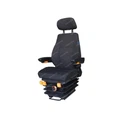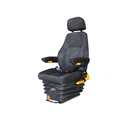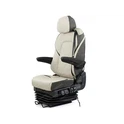


In the commercial vehicle seating industry, many people often confuse truck seats with construction machinery seats, and even assume that they are interchangeable. However, the two types of seats are designed for completely different working environments, with significant differences in their design concepts, functions, and performance requirements.

1. Fundamental Differences in Vibration Sources and Working Conditions
The core function of a vehicle seat is vibration reduction. To achieve effective shock absorption, seat designers must first understand the vibration characteristics, including frequency, direction, and impact intensity generated by different vehicles.
Truck Seats (Heavy-Duty Trucks / Tractor Trucks)
Trucks mainly operate on highways, national roads, and long-distance transportation routes.
Their operating conditions include:
High-speed driving;
Continuous low and medium-frequency vertical and longitudinal vibrations;
Long driving periods, usually 4–8 hours or more per day.
Therefore, truck seats focus on:
Excellent ride comfort;
Reduced driver fatigue;
Long-term ergonomic support;
Stable suspension performance during extended driving.
Construction Machinery Seats (Excavators / Wheel Loaders / Mining Trucks / Rollers)
Construction machinery mainly operates in challenging environments such as mines, construction sites, and off-road areas.
Compared with trucks, these machines experience:
- Low-speed but high-impact shocks;
- Large-amplitude vibrations caused by uneven terrain;
- Multi-directional movements caused by equipment operation, including forward/backward, lateral, and tilting movements.
- Therefore, construction machinery seats are designed for:
- Strong impact absorption;
- Better body support and protection;
- Higher durability;
- Improved operator safety in harsh environments.
2. Differences in Suspension System Tuning
Although premium truck seats and construction machinery seats both widely use air suspension technology, their suspension tuning principles are significantly different.
1. Suspension Travel and Natural Frequency
Truck Seats
Truck seats are designed to provide a smooth and comfortable driving experience.
Typical characteristics:
- Suspension travel is usually around 60mm–100mm;
- The suspension system is optimized for continuous road vibrations;
- Height control valves maintain the seat at an ideal suspension position.
The goal is to effectively filter road vibrations and prevent excessive body movement, ensuring comfort during long-distance driving.
Construction Machinery Seats
Construction machinery seats need to handle sudden and severe impacts.
Typical characteristics:
- Longer suspension travel, usually 80mm–120mm or more;
- Equipped with high-performance dampers;
- Designed with bump stops to prevent bottoming out.
When equipment suddenly drops into holes or encounters rough terrain, these systems help prevent the seat from directly hitting the bottom structure and transferring harsh impacts to the operator.
2. Multi-directional Suspension
Truck Seats
Truck seats mainly focus on vertical vibration isolation.
Some premium models also include:
- Longitudinal suspension systems;
- Additional shock absorption for braking forces or trailer impacts.
Construction Machinery Seats
Construction machinery seats require more comprehensive vibration control.
In addition to vertical and forward/backward suspension, many mining and heavy-duty machines require:
- Horizontal suspension;
- Side-impact vibration control.
These features help reduce lateral movement when operating on slopes, uneven ground, or during turning maneuvers.
3. Differences in Ergonomic Design
Besides suspension systems, truck seats and construction machinery seats also differ significantly in human-machine interaction.
| Comparison | Truck Seats | Construction Machinery Seats |
|---|---|---|
| Application | Long-distance transportation | Construction sites and mining operations |
| Main Requirement | Comfort and fatigue reduction | Shock protection, safety, and durability |
| Operation Method | Steering wheel driving | Joystick and control lever operation |
| Armrest Design | Comfort-oriented armrests | Armrests integrated with control consoles |
| Rotation Function | Limited rotation | Common 90°/180° rotation options |
| Seat Material | Breathable and comfortable fabrics | Waterproof, oil-resistant, tear-resistant materials |
| Durability Requirement | Long-term comfort | High-intensity working conditions |
For construction machinery such as excavators, the seat often needs to integrate control systems:
- Joysticks are installed directly on the armrests;
- The armrest and seat structure require strong rigidity;
- Controls must remain stable while the seat moves with the suspension system.
4. Purchasing and Selection Guide
For B2B buyers and vehicle manufacturers, truck seats and construction machinery seats should not be selected interchangeably.
The correct choice should be based on the actual operating environment.
Consider the Air Supply System
Truck seats can usually connect directly to the vehicle's existing air supply system.
However, some small and medium-sized construction machines, such as compact loaders, may not have an onboard air source.
In these cases, buyers should consider:
Air suspension seats with built-in 12V/24V electric compressors;
Or high-performance mechanical suspension seats.
Consider Application Requirements
Long-distance transportation vehicles → Choose truck-specific air suspension seats.
Excavators, loaders, mining equipment, and off-road machinery → Choose construction machinery seats designed for heavy impacts and harsh environments.
Conclusion
Truck seats and construction machinery seats are not simply different versions of "high-end" and "standard" products. They are specialized solutions developed for completely different operating conditions.
Truck seats focus on long-distance comfort, ergonomic support, and fatigue reduction, while construction machinery seats focus on shock absorption, operator protection, and durability in extreme environments.
Understanding the differences in vibration characteristics, suspension requirements, control integration, and environmental resistance is essential for building a high-performance operator cabin system.
For professional applications, YSR Seating provides reliable truck seats and construction machinery seat solutions, including air suspension seats, mechanical suspension seats, and OEM customization services. With designs optimized for different vehicle applications, YSR helps manufacturers and operators improve comfort, safety, and productivity across trucks, excavators, wheel loaders, mining equipment, and other heavy-duty vehicles.