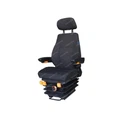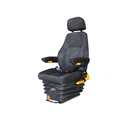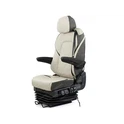


Every mile driven on a rough road sends vibration traveling upward through a truck's frame, through the floor, and directly into the driver's body. Over hours, days, and years, this relentless exposure takes a measurable toll - spinal degeneration, chronic lower back pain, and accelerating fatigue are all well-documented consequences of prolonged whole-body vibration (WBV). The seat a driver sits in is the single most critical barrier between that vibration and their body. This is precisely why upgrading to a Truck Mechanical Suspension Seat - such as the YSR 911-5B from YSR Seating Factory - represents one of the most impactful investments a fleet operator or owner-operator can make. The real question is: how much vibration does a mechanical suspension seat actually absorb, and how does that compare to a standard rigid seat?
The Problem with Rigid Seats
A rigid seat, by definition, has no suspension mechanism. It is bolted directly to the vehicle floor, and whatever vibration the truck generates is transmitted almost entirely into the driver's body. Some rigid seats include foam padding that can attenuate very high-frequency buzz, but even the best padding offers less than 10% vibration reduction overall - and zero isolation in the frequency ranges that matter most.
The frequencies most dangerous to drivers fall between 4 and 8 Hz, a range produced by road roughness and engine harmonics that coincides almost exactly with the resonant frequency of the human spine. At these frequencies, rigid seats do not just fail to protect - they can actually amplify vibration, transmitting it at greater intensity than the floor itself. The driver effectively becomes part of the vehicle's vibration system, absorbing energy with no mechanical buffer whatsoever. For long-haul drivers spending 10 or more hours per day in the cab, this is not a comfort issue - it is a serious occupational health hazard.

How a Mechanical Suspension System Changes Everything
A mechanical suspension seat works on the principle of a spring-mass-damper system. A set of calibrated springs absorbs vertical energy from floor vibration, while hydraulic or friction dampers control the rate of rebound, preventing the seat from oscillating uncontrollably. A linkage mechanism keeps the seat platform level throughout its travel range. Together, these components create a secondary isolation system between the truck's vibrating floor and the driver's body.
The YSR 911-5B offers ±30 mm of suspension travel and is specifically tuned to target the 4–8 Hz frequency band where spinal damage risk is highest. This is not accidental engineering - it reflects a deliberate design philosophy of matching the mechanical suspension system's natural frequency to fall below the truck's primary vibration inputs, ensuring continuous isolation rather than amplification. At frequencies above the system's resonance point, the suspension decouples the driver from the floor, attenuating the energy before it reaches the seat surface.
Equally important is weight adjustment. The YSR 911-5B accommodates drivers ranging from 40 to 130 kg, and correct weight setting is essential to optimal performance. A suspension tuned for a 100 kg driver and ridden by a 60 kg driver will operate outside its effective range, potentially reducing isolation efficiency by more than 50%. Proper adjustment ensures the springs and dampers work within their designed operating window, delivering maximum vibration attenuation for every individual driver.
Quantifying the Difference: Absorption by Frequency Range
When comparing a rigid seat against a properly adjusted mechanical suspension truck seat, the performance gap is dramatic across every frequency band. In the critical 4–8 Hz spinal resonance range, a rigid seat provides essentially 0% isolation, while a quality mechanical suspension seat absorbs 40–60% of input vibration. For low-frequency inputs between 1 and 3 Hz - the pitch and roll associated with uneven terrain - mechanical suspension provides 30–50% absorption compared to near zero for a rigid seat. For shock events such as hitting a pothole or crossing a rail crossing, the reduction can reach 50–70%, dramatically reducing the peak forces transmitted to the driver's spine.
At very high frequencies above 20 Hz, mechanical suspension is admittedly less effective - this is a known limitation of passive systems. High-frequency vibration, such as tire imbalance buzz, is better attenuated by foam cushioning than by spring-based systems. A well-designed seat like the YSR 911-5B combines both mechanical suspension for low-to-mid frequency isolation and quality foam padding for high-frequency damping, providing comprehensive protection across the full vibration spectrum a truck driver encounters.
It is worth noting that these figures assume a properly adjusted and maintained seat. The mechanical suspension system requires periodic inspection of springs and rubber components to maintain performance over time. A neglected suspension with worn dampers or degraded springs will deliver progressively less isolation, drifting closer to the performance of a rigid seat as components age.
|
|
|
|
|


Real-World Impact for Drivers, Fleets, and Owner-Operators
The numbers tell part of the story, but the practical consequences of vibration reduction extend well beyond test data. For drivers, absorbing 40–60% less spinal vibration over an eight-hour shift translates directly into less fatigue, improved concentration, and reduced risk of the chronic musculoskeletal conditions that shorten careers. A driver who ends a shift feeling physically rested rather than beaten down is also a safer driver - reaction times improve, alertness is sustained, and the subtle cognitive erosion caused by sustained discomfort is avoided.
For fleet operators, the business case is equally compelling. Reduced WBV exposure correlates with lower rates of workers' compensation claims, decreased absenteeism, and improved driver retention. The cost of replacing an experienced driver - recruiting, training, lost productivity - typically far exceeds the cost of equipping a truck with a quality suspension seat. Additionally, compliance with occupational health regulations governing WBV exposure is increasingly a legal requirement in many jurisdictions, making mechanical suspension seating not just a comfort upgrade but a compliance investment.
For owner-operators, the calculation is more personal. Protecting your own health is protecting your livelihood. Back surgery, extended recovery periods, and chronic pain management represent far greater costs - financial and personal - than any seat investment. The YSR 911-5B's energy-independent design requires no compressed air or electrical connections, meaning it delivers consistent performance across any truck without the infrastructure demands of air suspension systems.

Conclusion
The performance gap between a rigid seat and a quality mechanical suspension seat is not marginal - it is substantial and measurable. While rigid seats transmit virtually all vibration directly to the driver's body, a properly adjusted Truck Mechanical Suspension Seat like the YSR 911-5B absorbs 40–60% of harmful mid-frequency vibration, reduces shock transmission by up to 70%, and significantly diminishes the cumulative health burden of a professional driving career. Backed by ISO9001-certified manufacturing, factory-direct pricing, and a mechanical suspension system specifically engineered for truck operating conditions, YSR Seating Factory offers a solution that balances performance, durability, and value.
Contact YSR Seating Factory today to learn more about the YSR 911-5B or to request specifications for your specific vehicle application.
📞Phone: +86-029-81136503
📧Email: sales@ysrseats.com
💬WhatsApp: +86-13991337062
📱WeChat: 18992819914
Related Articles
What's the difference between mechanical suspension and air suspension seats in trucks?
Do mechanical suspension truck seats reduce driver fatigue and back pain?
How do I choose the right mechanical suspension seat for my truck?
Will a mechanical suspension seat fit my truck's cab or mounting rails?
How do I install a mechanical suspension seat in a truck?
Can I install a mechanical suspension seat myself?
How much vibration do mechanical suspension seats absorb compared to rigid seats?
What are the key features of a good truck mechanical suspension seat?
What are the weight capacity and adjustment ranges for truck mechanical seats?
Are mechanical suspension seats worth the cost vs. air ride seats?