
When railway operators evaluate seating options, they typically weigh a long list of capabilities - rotation range, lumbar support, height adjustment, backrest recline, and more. Every Locomotive Cab Seat on the market today bundles several of these features together, making it genuinely difficult to decide which one matters most. Sales materials tend to highlight whichever feature photographs best or sounds most impressive in a specification sheet. But when you step back and ask which single feature has the greatest impact on driver health, operational safety, and long-term workforce sustainability, the answer comes down to one engineering priority: mechanical suspension. Understanding why requires a closer look at what locomotive drivers actually endure during a working shift - and what happens to the human body when the right protection is absent.
The Hidden Enemy: Rail Vibration
A locomotive does not glide smoothly along the track. It travels across steel rails with expansion joints, switches, grade crossings, curved sections, and surface imperfections - each one sending a jolt upward through the frame, through the cab floor, and directly into the operator's body. Individual jolts may seem minor, but the cumulative effect of continuous low-frequency and high-frequency vibration across an eight- or twelve-hour shift is significant. The energy travels up through the feet and seat pan, concentrating in the lumbar spine, where it compresses intervertebral discs and fatigues the deep stabilizing muscles of the lower back.
Research into whole-body vibration - the category that covers exactly this kind of occupational exposure - consistently shows that prolonged daily exposure above threshold levels accelerates degenerative disc disease, increases the incidence of lower back pain, and contributes to musculoskeletal disorders that can end careers prematurely. Railway drivers are among the occupational groups most consistently identified as high-risk in whole-body vibration studies, precisely because their exposure is continuous, daily, and unavoidable given the nature of the work environment.

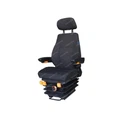
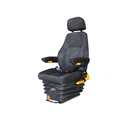
This is the problem that mechanical suspension solves - and why it must be considered the single most important feature when sourcing locomotive seats. A spring-based suspension system isolates the driver from vertical shocks before they reach the body. The mechanism works by allowing the seat pan to travel independently of the seat base within a defined range, absorbing and dissipating kinetic energy rather than transmitting it upward. Without suspension, even a perfectly contoured ergonomic seat becomes a rigid conductor of vibration. With it, the driver is effectively decoupled from the worst of the track's energy input across the full duration of the shift. The YSR911-41 from YSR Seating is built around precisely this principle: its mechanical suspension system absorbs vertical movement continuously, protecting the spine from the first mile to the last.
Comparing the Key Features
Acknowledging that suspension comes first does not mean other features are unimportant. Three contenders deserve honest consideration, and understanding where each fits in the hierarchy helps buyers make better decisions.
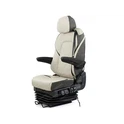
360° rotating base is genuinely valuable in a locomotive cab. Operators must frequently access rear-facing controls, check instruments at oblique angles, communicate with crew members positioned behind them, and respond to signals from multiple directions. A full-rotation seat allows all of this without the driver twisting their torso repeatedly, which over time can be its own source of injury - particularly to the thoracic spine and the muscles of the mid-back. For this reason, many Locomotive Cab Seat suppliers - including YSR Seating - treat rotation as a standard feature rather than a premium upgrade. The YSR911-41 includes a 360° rotating base as part of its standard configuration, recognizing that operational flexibility is inseparable from occupational safety.
Yet rotation remains a functional convenience rather than a foundational health protection. A driver who has developed chronic spinal damage from years of unmitigated vibration cannot be made comfortable simply by the ability to spin the seat. The pain and fatigue follow the operator regardless of which direction they face. Rotation enhances what is already a comfortable and well-supported seating position; it cannot create that position on its own.
Ergonomic design and lumbar support work on a different axis entirely. A well-designed ergonomic seat maintains the natural S-curve of the spine and distributes body weight evenly across the seat pan and backrest, preventing the postural collapse that occurs when drivers sink into an unsupportive surface over long periods. The YSR911-41's contoured backrest with integrated lumbar support keeps the operator in a biomechanically safe position, reducing the risk of both acute postural injury and chronic muscle fatigue. The backrest recline of 121° allows the driver to alternate between a forward-leaning active posture during demanding operational phases and a more supported, relaxed posture during lower-intensity stretches - a flexibility that meaningfully reduces cumulative spinal load over the course of a shift.
This is the runner-up feature, and it works best in direct combination with suspension. Suspension eliminates the primary energy input; ergonomics manages the body's static posture in response to what remains. Together, they address both the dynamic and the static dimensions of driver discomfort. Separately, each is significantly less effective.
Height adjustment and backrest recline round out the picture as important supporting features. A 60 mm vertical adjustment range accommodates drivers of different statures and ensures correct pedal reach regardless of leg length - a critical safety consideration, since a driver who cannot comfortably reach the controls will compensate with postural habits that introduce their own injury risks over time. The single-lock slide rail provides secure fore-and-aft positioning, ensuring the seat stays exactly where the operator sets it even under the vibration loads the suspension is managing. The heightened seat base improves sightlines to the track and surrounding signals, contributing to operational awareness and reducing the head and neck movement required to maintain visual contact with the environment outside the cab.

Each of these features matters. But none of them addresses the root cause of vibration-related injury. The conclusion is clear: suspension is the foundation. Rotation, ergonomics, and adjustability are the walls and roof - valuable, structurally important, but entirely dependent on what sits beneath them.
What to Look for When Sourcing Seats
For procurement managers and fleet operators comparing Wholesale Locomotive Seat options, the feature checklist should begin - not end - with suspension type. Seats marketed primarily on rotation range or visual design, without clearly specifying their vibration-isolation mechanism, warrant careful scrutiny. A seat that lists "high-density ergonomic foam" as its primary comfort feature is a passive product that manages existing discomfort; a seat with a documented mechanical suspension system is an active protective device that prevents discomfort from occurring in the first place. The distinction is not semantic - it has direct implications for driver health outcomes, sick leave rates, and long-term workforce sustainability.
Budget is always a real consideration in fleet procurement. Buyers searching for a low price Locomotive Seat should nonetheless be cautious about products that achieve low cost by eliminating or simplifying the suspension mechanism. The short-term unit savings are visible on a purchase order; the long-term costs - in driver injury claims, medical leave, reduced on-shift productivity, and accelerated crew turnover - are distributed across HR, operations, and insurance budgets in ways that rarely get traced back to the original seating decision. Investing in proper mechanical suspension at the point of purchase is considerably less expensive than managing its absence over a fleet's operational lifespan.
The YSR911-41 is positioned to address this trade-off directly. It is available at ex-factory pricing with no intermediary markup, a minimum order quantity of just one piece, and a 12-month warranty that reflects confidence in the product's build quality. ISO9001 certification confirms that manufacturing quality control meets internationally recognized standards - an important assurance for buyers who cannot inspect production facilities directly. For operators managing mixed fleets or phased replacement programs, the low MOQ means individual seat evaluation and trial is straightforward before committing to larger volumes.
For operators with non-standard cab configurations, Customized Locomotive Seat solutions are available through OEM and ODM programs. Cab dimensions, floor mounting plate configurations, armrest height and fold specifications, upholstery material grades, and color standards can all be adapted to specific rolling stock requirements. This flexibility is particularly valuable for operators running heritage or specialist locomotives where standard off-the-shelf dimensions do not fit, and for transit authorities with uniform interior design standards that must be maintained across the fleet. Customization through YSR Seating does not require buyers to compromise on the mechanical suspension core - it is the one element that remains non-negotiable, because it is the one element the seat cannot function properly without.
Making the Right Decision
The locomotive seating market includes many Locomotive Seat suppliers, and the differences between products are not always immediately apparent from a brochure or a product listing. Specification sheets can be selectively detailed - comprehensive on features that photograph well and vague on the engineering that matters most. The question every buyer should ask any supplier is straightforward: what is the suspension mechanism, how does it perform, and does the product comply with ISO 7096 or equivalent whole-body vibration attenuation standards? A supplier who answers that question with specific, verifiable data is a supplier who understands what a locomotive cab seat is actually required to do.

The most important feature of a Locomotive Cab Seat is mechanical suspension - because it addresses the single greatest physical threat to the operator's long-term health and working capacity. Everything else, from 360° rotation to lumbar contouring to single-lock slide rails and heightened seat bases, builds on that foundation and multiplies its benefit. The YSR911-41 delivers a complete package of all these capabilities, but its suspension system is where the protection begins, and where the value of every other feature is either supported or undermined.
Ready to protect your drivers, reduce injury-related operational costs, and invest in seating that performs across the full service life of your fleet? Contact YSR Seating today for a quote, sample request, or OEM/ODM customization consultation.
Phone: +86-029-81136503
Email: sales@ysrseats.com
WhatsApp: +86-13991337062
WeChat: 18992819914