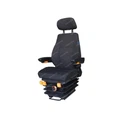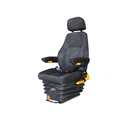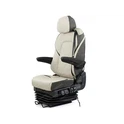


Every railway operator knows that a locomotive cab is a demanding workplace. Drivers spend hours - sometimes entire shifts - managing controls, monitoring signals, and absorbing the constant vibration of steel wheels on steel rails. At the center of that environment sits one critical piece of equipment that is easy to overlook: the Locomotive Cab Seat. Far from being a simple chair, a modern locomotive seat is a precisely engineered system designed to protect the driver's body, reduce fatigue, and support safe operation from the first mile to the last.
In short: A modern locomotive seat works by using a mechanical suspension system (spring and damper) to absorb rail-induced whole-body vibration, combined with ergonomic adjustments - 60 mm height range, 121° recline, 360° rotation, and fore-aft slide - plus safety locks that protect the driver and maintain focus across long shifts.
The Core Challenge: Vibration, Fatigue, and the Body
The fundamental problem a locomotive seat must solve is whole-body vibration. Every rail joint, switch, and imperfection in the track sends a mechanical shock upward through the cab floor and directly into the driver's spine. Over the course of a long shift - or a long career - this cumulative stress causes chronic back pain, spinal injury, and dangerous fatigue.
Modern locomotive seats address this with a layered engineering response that moves from vibration isolation at the base all the way to ergonomic contouring at the backrest. The table below shows how each layer of the system contributes to driver protection:
|
Step |
Component / Action |
Function |
|
1 |
Rail vibration input |
Vertical shock from wheel-rail contact |
|
2 |
Mechanical suspension (spring + damper) |
Absorbs and dissipates vibration energy before it reaches the driver |
|
3 |
Lumbar support + contoured backrest |
Maintains the spine's natural S-curve, reducing static muscle load |
|
4 |
Adjustment system (height / slide / recline / rotation) |
Accommodates different body types and postures, reducing localised fatigue |
|
5 |
Locking / safety mechanisms |
Keeps the seat in position, preventing movement during emergency braking |

The YSR911-41, developed by YSR Seating, demonstrates this principle in practice. Its mechanical suspension system works in coordination with an ergonomically contoured backrest that follows the natural curve of the spine. Built-in lumbar support reduces pressure on the lower vertebrae, maintaining healthy posture even during extended stationary periods. Together, these features turn what could be an orthopedic liability into a genuine safety asset.
Adjustability: Fitting Every Driver
A suspension system alone is not enough. Drivers vary widely in height, weight, and preferred working posture, and a seat that fits one operator poorly will undermine every ergonomic benefit it offers. This is why adjustability is the second major engineering priority in any quality Wholesale Locomotive Seat designed for fleet use.
|
Adjustment |
Range / Specification |
Purpose |
|
Vertical height |
60 mm |
Matches driver stature; feet flat on floor, optimised sightlines |
|
Fore-aft slide rail |
Single-lock, adjustable travel |
Sets precise distance from the control desk; stable when locked |
|
Backrest recline |
121° total (80° forward + 41° rearward) |
Active driving posture or relaxed position; reduces spinal pressure |
|
Rotating base |
Full 360°, lockable |
Access rear instruments without twisting the torso |
The single-lock fore-and-aft slide rail lets the driver set their precise distance from the control desk, and once locked, holds that position firmly - an important safety consideration during emergency braking or sudden acceleration. The 360-degree rotating base allows the driver to turn and access rear-mounted instruments or communication panels without the repeated torso twisting that, over a career, is a common source of back and shoulder injury.
Safety Mechanisms Built Into the Design
Every adjustment feature in a locomotive seat doubles as a safety mechanism. Among Locomotive Cab Seat suppliers, the quality of these locking and securing systems is one of the most important differentiators between a professional product and a basic one.
|
Safety Mechanism |
Function |
When It Matters |
|
Single-lock slide rail |
Locks seat position firmly |
Prevents shifting during emergency braking or sudden acceleration |
|
Secure floor mounting (ISO 9001) |
Bolts the entire assembly to the cab structure |
Maintains structural integrity in crash or derailment situations |
|
Height and rotation adjustment |
Ensures all controls are within reach for every driver stature |
Prevents a critical control being missed or delayed in an emergency |
|
Post-adjustment lock verification |
Confirms each mechanism is engaged before operation |
Prevents unintended movement during the shift |

Understanding these mechanisms also has practical value for fleet managers and maintenance teams. Knowing how the suspension, slide rail, and rotation bearing work makes routine inspection and servicing straightforward. Worn dampers, stiff locking mechanisms, or degraded foam can all be identified and corrected before they affect driver performance.
Customization, Value, and Choosing the Right Supplier
Not all rail environments are the same. High-speed intercity locomotives, urban subways, freight trains, and shunting vehicles each expose drivers to different vibration profiles, control layouts, and shift lengths. Buyers looking for a Customized Locomotive Seat solution need a manufacturer that can modify suspension tuning, adjustment ranges, mounting patterns, and upholstery to match specific operational requirements.
|
Advantage |
Detail |
|
Factory-direct pricing |
No distributor markup - ex-factory cost passed directly to the buyer |
|
Low minimum order |
MOQ 1 piece - suitable for trials, single replacements, or fleet rollouts |
|
OEM / ODM capability |
Mounting brackets, dimensions, fabric, colour, and features modified to drawing |
|
Sample support |
Working sample available before committing to mass production |
|
Warranty |
12 months against manufacturing defects |
|
Certification |
ISO 9001 quality management system |

For procurement teams managing larger fleets, working with experienced Locomotive Seat suppliers who offer OEM and ODM services is a significant advantage. Direct factory pricing makes it possible to equip an entire fleet at a low price Locomotive Seat cost that does not compromise on engineering quality. As technology evolves, locomotive cab seats are beginning to integrate with broader cab systems - augmented reality displays, sensor-based fatigue monitoring, and active suspension are all under development - making the seat not just an ergonomic decision, but a long-term infrastructure investment.
Frequently Asked Questions
How does a modern locomotive seat work?
A modern locomotive seat uses a mechanical suspension system - spring and damper - to absorb rail-induced whole-body vibration. Combined with 60 mm height adjustment, 121° backrest recline, 360° rotation, and a lockable fore-aft slide rail, it keeps the driver correctly positioned, protected, and focused across long shifts.
Why do locomotive seats need suspension?
Rail joints and track imperfections generate continuous vertical shock. Without suspension, this energy transfers directly to the driver's spine, causing fatigue and long-term injury. Mechanical suspension absorbs and dissipates that energy before it reaches the operator.
What adjustments are available on a modern locomotive seat?
Standard adjustments include vertical height (60 mm range), fore-aft slide with single-lock, backrest recline across a 121° total arc, and full 360° rotation with locking positions. These accommodate different driver body types and working postures throughout a shift.
Can a locomotive seat be customised for a specific cab?
Yes. YSR Seating offers OEM and ODM customisation covering mounting brackets, overall dimensions, fabric type, colour, and optional features - with sample production available before bulk orders are placed.

Conclusion
A modern locomotive seat is a coordinated engineering system: mechanical suspension that isolates the spine from rail vibration, multi-directional adjustments that fit every driver precisely, safety-locking mechanisms that hold position under extreme forces, and ergonomic contours that protect posture across years of daily use. The YSR911-41 brings all of these principles together in a single product backed by ISO 9001 certified manufacturing.
Want to see how the right locomotive seat can improve driver safety and comfort across your fleet? Contact YSR Seating today for a quote, a sample request, or a customized OEM/ODM solution - with ex-factory pricing, no middlemen, MOQ 1 piece, and a 12-month warranty included.
Phone: +86-029-81136503
Email: sales@ysrseats.com
WhatsApp: +86-13991337062
WeChat: 18992819914