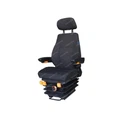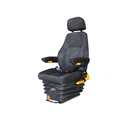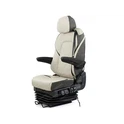


If you operate a truck, tractor, forklift, or any heavy-duty vehicle for long hours, the type of seat suspension you choose has a direct impact on your comfort, health, and productivity. Many drivers are still unsure whether to invest in an Air Suspension Seat For Vehicle or stick with a traditional mechanical suspension seat. While both are designed to reduce the shock and vibration transferred from the road to the driver, they work in fundamentally different ways - and those differences matter enormously over the course of an 8- to 10-hour shift. This article breaks down the key distinctions between the two technologies so you can make an informed decision.
How Each Suspension Type Works
A mechanical suspension seat operates on a straightforward principle: steel coil springs or torsion bars act as a buffer between the seat platform and the vehicle chassis. When the vehicle hits a bump, the springs compress and rebound to absorb the impact. This design is simple, durable, and inexpensive to manufacture and repair, which is why mechanical seats have been the industry standard for decades. However, their limitations become apparent in demanding environments. Steel springs have a fixed rate - they cannot adapt to different driver weights or varying road conditions. Under heavy loads, the seat gradually sinks, reducing available suspension travel and leaving the driver more exposed to vibration. On rough terrain or construction sites, mechanical seats can bottom out or rebound sharply, sending jarring shocks directly up the driver's spine.
An air suspension seat for truck, tractor, or other heavy vehicle works on an entirely different principle. Instead of rigid metal springs, it uses a flexible air spring - essentially a pressurised air bag - combined with a hydraulic shock absorber and an automatic height control valve. The air spring continuously adjusts its stiffness in response to road inputs, providing a progressive, cushioned response to both small vibrations and large impacts. The automatic height control valve maintains the seat at a consistent mid-stroke position regardless of the driver's weight or load conditions, meaning the full suspension travel is always available. This is the core advantage that separates true air suspension from everything else on the market.
Key Differences: A Side-by-Side Comparison
The practical differences between the two systems become clear when you compare them across the factors that matter most to working drivers.
When it comes to vibration isolation, air suspension is in a different league. Steel springs in mechanical seats transmit fine, high-frequency vibrations directly to the driver's body. Over hours of operation, this constant micro-vibration contributes to fatigue, back pain, and long-term musculoskeletal damage. Air suspension seats, by contrast, absorb both low-frequency shocks and high-frequency vibrations, keeping the driver isolated and stable regardless of the surface beneath the wheels. Studies consistently show that drivers using air suspension report significantly lower fatigue levels at the end of long shifts.
Weight adjustment is another critical difference. A quality air suspension seat for tractor or truck will allow the driver to dial in the suspension stiffness to match their body weight - typically across a range of 40 kg to 130 kg. This means the seat performs optimally whether it is being used by a lightweight operator or a heavier one, and it adapts instantly when different drivers share the same vehicle. Mechanical seats, on the other hand, are built around a fixed spring rate. Some models offer a limited manual pre-load adjustment, but they simply cannot match the precision or range of a true air system.
Ride height consistency is where mechanical seats truly fall short. Because the spring compression is determined by the driver's weight, a heavier operator will sit lower, with less suspension travel available above them. An air suspension system eliminates this problem entirely - the automatic height valve ensures the seat always returns to the optimal mid-stroke position, giving every driver the same safe, consistent ride regardless of their weight.
Adjustability is also dramatically superior in air suspension models. A premium truck air suspension seat like the YSR914-53P offers independent front and rear height adjustment across seven positions each, backrest recline from 45° to 180°, fore-and-aft slide of 230 mm across 23 locking positions, a three-gear head restraint, and optional lumbar support, seat depth adjustment, armrests, and even a 360° rotation base. Mechanical seats typically offer a basic cushion tilt and a limited slide rail - far fewer options for tailoring the seat to the individual driver's body and working posture.

Real-World Performance: Where the Gap Is Most Visible
The difference between the two systems is most pronounced in the conditions where drivers spend the most time and face the greatest physical demands.
On smooth highways, a mechanical seat can perform adequately. But move to rough country roads, muddy farm tracks, or a construction site covered in rubble and debris, and the gap becomes immediately apparent. Air suspension seats for pickup trucks and heavy equipment allow the driver to absorb impacts that would send a mechanical seat bouncing violently. On off-road terrain, a mechanical seat's springs can bottom out repeatedly, creating a harsh, jolting ride that leaves drivers exhausted and sore. An air suspension system, by contrast, responds progressively to each input, maintaining a smooth, controlled motion even over severe obstacles.
For long-shift drivers - whether they are operating a long-haul truck, a farm tractor during harvest, or a forklift in a warehouse - the cumulative effect of vibration exposure is a serious occupational health concern. Research links prolonged whole-body vibration to chronic lower back pain, disc degeneration, and reduced cognitive alertness. An air suspension seat for tractor or truck does not just make the ride more comfortable; it actively protects the driver's health and keeps them more alert and productive throughout the day. The mechanical seat's inability to isolate fine vibration makes it a genuine long-term liability for drivers and fleet operators who take occupational health seriously.
Cost, Value, and Total Ownership
The upfront cost of an air suspension seat is higher than a comparable mechanical model. A quality mechanical seat might be purchased for $150 to $300, while a genuine air suspension seat typically starts at $400 and can reach $1,500 or more for premium models with full accessories. However, this comparison is misleading if it stops at the purchase price.
A mechanical seat in a demanding application may need to be replaced every two to three years as the springs sag, the frame fatigues, and the adjustment mechanisms wear out. A well-built air suspension seat, manufactured to ISO9001 standards with quality materials, will routinely last five to ten years or more. When you factor in replacement costs, installation time, and lost productivity from driver fatigue and injury, the air suspension seat almost always delivers better total value.

Buying factory-direct from a manufacturer like YSR Seating removes another layer of cost. Eliminating the distributor markup means you can access a premium air suspension seat for truck or tractor at ex-factory pricing - significantly lower than retail - without sacrificing quality, warranty, or after-sales support. With a minimum order quantity of just one piece and worldwide shipping, factory-direct purchasing is now a practical option for individual owner-operators and large fleet managers alike.
Conclusion: Which Seat Is Right for You?
The choice between an air suspension seat and a mechanical seat ultimately comes down to what you expect from your vehicle seating over the long term. If your application is light, your shifts are short, and budget is the primary constraint, a mechanical seat may be sufficient. But for any driver who spends serious hours behind the wheel - whether in a long-haul truck, a farm tractor, a construction machine, or a heavy pickup - the case for air suspension is overwhelming.
Superior vibration isolation, automatic ride height control, precise weight adjustment, and a far broader range of ergonomic fine-tuning combine to make air suspension seats the clear choice for professional drivers who value their comfort, health, and performance. The YSR914-53P represents exactly this kind of premium air suspension engineering, available at factory-direct prices with full customisation support.
Ready to upgrade from mechanical to air suspension? Contact YSR Seating today for a free, no-obligation factory-direct quote. Ask about the YSR914-53P, optional accessories, OEM/ODM customisation, and bulk discounts. One piece MOQ - we ship worldwide.
Phone: +86-029-8113650
Email: sales@ysrseats.com
WhatsApp: +86-13991337062
WeChat: 18992819914
Related Articles
What is the difference between air suspension seat and mechanical seat?
Where are air suspension seats used?
Do air ride seats reduce back pain?
Are air suspension seats good for long-distance driving?
How much vibration do air suspension seats reduce?
Air suspension seat vs mechanical seat – which is better?