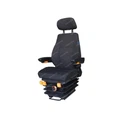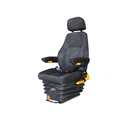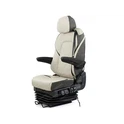


Professional drivers spend thousands of hours behind the wheel every year, and vibration is one of the most persistent threats to their health and performance. Whether you operate a long-haul truck, a farm tractor, or a pickup, the constant jolts and oscillations transmitted through your seat can cause cumulative damage to your spine, trigger chronic fatigue, and shorten your working day. The physical toll is invisible at first - a dull ache after a long shift, stiffness in the lower back on Monday morning - but over months and years, it compounds into serious musculoskeletal conditions that can end careers prematurely. Investing in a quality Air Suspension Seat For Vehicle is one of the most effective steps a driver or fleet manager can take - but how much vibration does it actually eliminate? This article breaks down the science, the numbers, and the real-world benefits so you can make an informed decision.
Understanding Vibration Exposure and Why It Matters
Whole-body vibration (WBV) is measured in meters per second squared (m/s²) and is categorized by frequency in hertz (Hz). The human spine is particularly vulnerable in the 4–8 Hz range, which is unfortunately the same frequency range generated by road surfaces, engine movement, and terrain irregularities. Long-term exposure above the action value of 0.5 m/s² - as set by the EU Directive 2002/44/EC - is linked to lower back pain, disc degeneration, and musculoskeletal disorders. In many countries, employers are legally required to monitor and mitigate WBV exposure for professional drivers, making seat selection not just a comfort issue but a compliance issue.
The sources of vibration in a working vehicle are numerous and simultaneous. Engine idle creates a continuous low-amplitude oscillation throughout the cab. Road surface texture - from highway expansion joints to gravel tracks - generates broadband vibration that spans both low and high frequencies. Load shifts in a truck trailer alter the vehicle's dynamic response, sometimes dramatically. In agricultural settings, the soil itself becomes a vibration source, with each pass over a furrow or drainage channel sending a sharp transient shock directly up through the chassis. When all of these inputs combine, the total vibration dose experienced by a driver over an eight-hour shift can exceed occupational safety limits by a factor of two or more when using an inadequate seat.

For truck drivers, a standard rigid or basic mechanical seat transmits nearly all of this energy directly to the operator. Studies show that an air suspension seat for truck applications can cut transmitted vibration at the seat pan by as much as 60%, bringing daily exposure values well within safe limits. That difference is not just about comfort - it is a matter of occupational health and legal compliance for fleet operators.
How Air Suspension Seats Reduce Vibration
The core technology inside a modern truck air suspension seat relies on three integrated components working together: an air spring (air bag), a hydraulic shock absorber, and an automatic height-control valve.
The air spring functions as a low-pass filter. It freely absorbs low-frequency movement - such as the slow body roll of a vehicle on a highway - while blocking the sharper, high-frequency jolts that travel from the road surface into the cab. Unlike a conventional coil spring, which has a fixed stiffness rate, an air spring's stiffness changes progressively with load. This means it responds gently to small bumps and then stiffens appropriately to absorb larger impacts, all without manual adjustment. The result is a more consistent isolation performance across the full range of road conditions a driver encounters during a typical working day.
The shock absorber controls rebound, preventing the seat from bouncing back too aggressively after each impact. Without effective damping, even a well-designed air spring can allow the seat to oscillate at its natural frequency - which, critically, can fall within the 4–8 Hz danger zone. The hydraulic damper suppresses these oscillations quickly, returning the seat to its neutral position smoothly and without secondary bounce. Meanwhile, the automatic height-control valve continuously keeps the seat in its optimal mid-stroke position regardless of driver weight, ensuring the suspension always has full travel available in both directions.
A further refinement found in premium air suspension seats is independent front-to-rear height adjustment, which allows the driver to fine-tune the seat angle in addition to ride height. This matters for vibration isolation because the path that vibration takes through the body is influenced by posture. A driver seated with a slight forward tilt distributes spinal loading differently from one seated upright, and the ability to customize this angle means the remaining vibration energy that does pass through the seat is directed away from the most vulnerable sections of the lumbar spine.
When properly adjusted, air suspension seats of this design can reduce transmitted vibration by 50–70% compared to rigid seats, and by 30–40% compared to conventional mechanical spring seats. At the critical 4–8 Hz range where the spine is most at risk, reduction rates frequently exceed 60%. The difference in practice is dramatic: a driver who experiences peak accelerations of 2–3g on rough terrain may feel less than 0.5g at the seat surface with a well-tuned air suspension system.

For agricultural applications, the gains are even more significant. An air suspension seat for tractor must contend with far more unpredictable inputs - furrows, rock beds, uneven ground - compared to a paved road environment. On these surfaces, a quality air suspension seat extends the safe daily exposure window from roughly 4 hours to 10 or more, allowing operators to work full shifts without breaching health guidelines. Tractor manufacturers increasingly specify air suspension seating as standard equipment on mid-range and premium models precisely because the productivity and health benefits are so well documented.
Seat Type Comparison: Vibration Transmission at a Glance
|
Seat Type |
Vibration Transmission |
Fatigue Onset |
Back Pain Risk |
|
Rigid (no suspension) |
100% (baseline) |
Within 1–2 hours |
Very high |
|
Mechanical spring |
60–80% |
2–4 hours |
High |
|
Air suspension |
30–50% |
5–8+ hours |
Low |
This table illustrates a consistent pattern across vehicle types. Whether you are fitting air suspension seats for pickup trucks used on construction sites or equipping a heavy-duty cab-over truck for intercontinental routes, the performance advantage of air suspension over mechanical alternatives is substantial and measurable.
It is worth noting that pickup truck drivers are an often-overlooked group when it comes to WBV risk. Because pickups are used in both on-road and off-road environments, and drivers frequently spend full workdays behind the wheel on job sites, utility routes, or rural access roads, the cumulative vibration exposure can rival that of a long-haul trucker. Upgrading to air suspension seats for pickup trucks can meaningfully reduce spinal loading over the course of a working year, particularly for tradespeople, land managers, and emergency service personnel who rely on their trucks as a daily working tool.
Health, Productivity, and Real-World Benefits
The reduction in transmitted vibration translates directly into measurable improvements for both individual drivers and fleet operators. Long-term studies on professional drivers show that switching to air suspension seating reduces lower back pain incidence by 50–70%. Fleets that have made the switch report up to 40% fewer back-related sick days, which represents a significant reduction in both human cost and operational downtime. When you factor in the cost of temporary replacement drivers, medical leave administration, and potential workers' compensation claims, the return on investment from a quality air suspension seat becomes compelling very quickly.
Beyond injury prevention, there is a strong productivity case. A driver who is not battling fatigue and discomfort remains alert for longer, makes better decisions, and can complete more hours of productive driving per day. Research in occupational ergonomics consistently shows that physical discomfort impairs concentration and increases reaction times - consequences that matter enormously when a driver is managing a 40-tonne vehicle at highway speeds or operating heavy agricultural machinery in confined spaces. The cognitive load of managing constant physical discomfort is a hidden drain on performance - one that quality air suspension seats effectively eliminate.
The benefits extend to the vehicle itself. Operators seated comfortably and without distraction handle controls more smoothly, reducing unnecessary wear on transmission, braking, and steering components. In a large fleet, this translates to lower maintenance costs and extended vehicle service life. Properly isolated operators are also less likely to cause inadvertent damage through overcorrection or delayed reaction - a benefit that compounds across a large fleet over time.

There is also an important recruitment and retention dimension for fleet operators to consider. In an industry where experienced drivers are in short supply, the quality of the working environment is a genuine differentiator. Drivers talk to each other, and a reputation for investing in operator comfort - including premium seating - can help attract and retain skilled personnel who have choices about where they work.
Conclusion
A properly specified and adjusted air suspension seat reduces transmitted whole-body vibration by 50–70% compared to rigid or mechanical alternatives, with peak reductions exceeding 60% in the frequency range most harmful to the human spine. For truck drivers, tractor operators, and pickup users alike, this translates into less back pain, less fatigue, longer safe working hours, and fewer health-related absences. The technology is proven, the health case is clear, and the productivity gains make the investment straightforward to justify.
The YSR914-53P from YSR Seating Factory is engineered to deliver exactly this level of performance. With a weight adjustment range of 40–130 kg, automatic ride-height control, independent front and rear height adjustment across seven gears per direction, and premium composite knitted and leather materials, it is a factory-direct solution for operators who demand serious vibration isolation. ISO9001 certified, backed by a one-year warranty, and available with full OEM and ODM customization to match the specific vibration profile of your vehicle type, it ships worldwide with a minimum order of just one piece - meaning individual operators and large fleets alike can access factory pricing without intermediary markups.
Ready to reduce vibration and protect your drivers? Contact YSR Seating today for a quote on the YSR914-53P and ask about custom tuning for your specific application:
Phone: +86-029-81136503
Email: sales@ysrseats.com
WhatsApp: +86-13991337062
WeChat: 18992819914
Related Articles
What is the difference between air suspension seat and mechanical seat?
Where are air suspension seats used?
Do air ride seats reduce back pain?
Are air suspension seats good for long-distance driving?
How much vibration do air suspension seats reduce?
Air suspension seat vs mechanical seat – which is better?