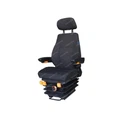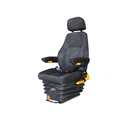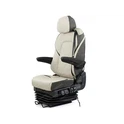


High-speed trains typically operate at speeds of 150–300 km/h. The operating environment is characterized not by violent jolts, but rather by the need to withstand high-frequency micro-vibrations and longitudinal inertial forces during acceleration and braking.

Their core features can be summarized as follows:
Rigidity and Stability: Trains are subjected to intense aerodynamic forces when cornering at high speeds, entering or exiting tunnels, or passing other trains. The seat's guide rails, rotation mechanisms, and locking systems must possess exceptional rigidity to remain rock-solid under all conditions.
International Rail Fire Safety Standards: As safety-critical components in enclosed public transport, all non-metallic materials used in the seat (fabrics, foam, plastics) must meet stringent rail fire safety standards (such as the EU's EN 45545-2 HL3 rating). They must be flame-retardant and exhibit characteristics such as extremely low smoke density and the absence of toxic gas emissions.
High-Frequency Micro-Vibration Damping: Although tracks are smooth, the hard contact between steel rails and wheels generates continuous, high-frequency, low-amplitude micro-vibrations. The seat base integrates a precision air-suspension or mechanical micro-vibration isolation system-combined with high-resilience foam-specifically designed to filter out these vibrations and prevent occupational fatigue for the driver.
Multi-Dimensional Dynamic Ergonomic Adjustability: High-speed train drivers must maintain constant focus and frequently perform manual confirmation gestures. These seats typically support 360° omnidirectional rotation and locking, full-unit electric height adjustment, seat cushion depth adjustment, and multi-point pneumatic lumbar support, ensuring drivers of all body types can align perfectly with the control console.

Commercial/Construction Vehicle Seats vs. High-Speed Train Driver Seats:
Traditional seats (such as the YSR 4-spring or standard air-suspension models) focus on mitigating large-amplitude vertical shocks caused by uneven road surfaces. In contrast, high-speed train driver seats prioritize addressing high-frequency micro-vibrations, longitudinal shear forces, and rigorous fire safety requirements. While their operating environments differ, the technical pursuit of structural rigidity and precision vibration damping remains fundamentally the same.
Phone: +86-029-81136503
Email: sales@ysrseats.com
WhatsApp: +86-13991337062
WeChat: 18992819914