

Anyone who has spent long hours behind the wheel of a heavy-duty vehicle knows how brutal road vibration can be on the body. A Truck Mechanical Suspension Seat is engineered specifically to address this challenge - absorbing shocks, reducing driver fatigue, and protecting long-term spinal health without relying on any external power source. Whether you operate trucks, tractors, or construction equipment, understanding how these seats work can help you make a smarter investment in operator comfort and safety.
What Is a Mechanical Suspension Seat?
A mechanical suspension seat is a seating system that uses purely mechanical components - springs, linkages, and dampers - to isolate the driver from vibrations and impacts generated by the vehicle and terrain below. Unlike air suspension seats that depend on a compressor and pneumatic supply, or active suspension systems that require electronic controls, a mechanical suspension seat operates independently of any vehicle system. This makes it a highly reliable and energy-independent solution across a wide range of working environments.

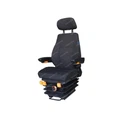
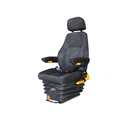
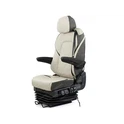
The YSR 911-5B is a well-regarded example of this seat category. Designed for heavy-duty use, it supports operators weighing between 40 and 130 kg and is adaptable to trucks, agricultural machinery, and industrial vehicles alike.
Core Working Principle: The Mechanical Suspension System
At the heart of every mechanical suspension system is a simple but effective principle: allow controlled vertical movement between the seat and the vehicle floor, so that shocks from bumps, ruts, and uneven terrain are absorbed before they reach the driver's body.
This is achieved through three interconnected elements:
1. The Spring Mechanism A heavy-duty coil or leaf spring sits at the core of the suspension. When the vehicle hits a bump, the spring compresses, absorbing the upward force. It then extends again as the vehicle levels out. The spring rate is tuned to handle the full range of operator weights effectively.
2. The Damping System A spring alone would cause the seat to bounce continuously after each impact. The damper - either friction-based or hydraulic - controls this rebound. It dissipates energy from the oscillating spring, bringing the seat back to a neutral position quickly and smoothly. This prevents the uncomfortable "bobbing" effect that reduces driver focus and comfort.
3. The Articulating Linkage A scissor-style or parallel linkage connects the seat platform to the base. This linkage allows vertical travel (typically ±60 mm) while keeping the seat level and stable. The geometry ensures that as the seat rises and falls, it moves in a controlled, predictable arc rather than tilting or shifting sideways.
Together, these three components form a passive but highly effective mechanical suspension system that requires no electricity, no compressed air, and no electronic calibration.
Key Adjustable Components
What separates a professional-grade mechanical suspension truck seat from a basic fixed seat is its range of adjustability. Every driver has a different body size, weight, and preferred posture, and the seat must be set up correctly to deliver optimal vibration isolation.
- Weight Adjustment Dial: This sets the spring preload. If the preload is set too low for a heavier operator, the suspension will bottom out on every bump. Set too high for a lighter operator, and the spring won't compress at all - eliminating the cushioning effect entirely. Correct weight setting is the single most important adjustment.
- Horizontal Slide (200 mm stroke): Allows the driver to move the seat forward or backward to comfortably reach pedals and controls.
- Height and Rake Adjustment (±60 mm / ±12°): Lets the operator raise or lower the seat and tilt the base angle for better sightlines and posture.
- Backrest and Headrest Adjustments: Support the lumbar region and neck, which is critical during long operating shifts.
When all these adjustments are dialed in correctly, the mechanical suspension seat delivers its full protective benefit - significantly reducing whole-body vibration (WBV) exposure, which is linked to chronic back pain and musculoskeletal disorders in professional drivers.
|
|
|
|
|


Advantages of Mechanical Suspension in Trucks and Machinery
The appeal of the mechanical suspension truck seat comes down to several practical advantages that are hard to match with more complex systems:
- Reliability: With no electronics or pneumatics involved, there is very little that can go wrong. The seat functions the same on day one as it does five years later, even in dusty, muddy, or extreme-temperature environments.
- Energy Independence: No compressor connection or electrical hookup is needed. This makes mechanical seats compatible with virtually any vehicle, including older models without modern cab infrastructure.
- Low Maintenance: Periodic inspection of springs, rubber bump stops, and linkage pivot points is all that's typically required. Parts are inexpensive and widely available.
- Cost-Effectiveness: Mechanical suspension seats offer a lower purchase price and longer service life compared to air or active suspension alternatives, delivering excellent value over time.
Limitations to Keep in Mind
No suspension system is without trade-offs. A mechanical suspension seat is a passive system - it cannot adapt in real time to changing conditions the way an active electronically controlled seat can. It performs best within a low-to-mid vibration frequency range, which covers the majority of road and field conditions but may be less effective against very high-frequency vibrations. Performance also depends heavily on correct setup; an improperly adjusted weight dial will noticeably reduce effectiveness. Springs and rubber components should be inspected periodically, especially in high-hour applications.
Why Choose YSR Seating Factory?
YSR Seating Factory specializes in professional-grade suspension seating for trucks, agricultural machinery, and industrial vehicles. As a direct manufacturer, YSR offers competitive factory pricing without middleman markups, along with OEM and ODM customization to meet specific vehicle and application requirements. All seats are backed by a 1-year warranty and comprehensive after-sales support, with global shipping available via air, sea, or express courier.

Conclusion
A truck mechanical suspension seat is one of the most cost-effective investments you can make in driver health and productivity. By using a well-tuned spring, damper, and linkage system, it dramatically reduces the vibration and shock that cause fatigue and long-term injury - with no power required. Whether you need a reliable solution for long-haul trucks or durable seats for mechanical suspension system, YSR Seating Factory has the expertise and product range to meet your needs.
Ready to upgrade your operator's seat? Contact YSR Seating Factory today for expert advice and a free quote.
Phone: +86-029-81136503
Email: sales@ysrseats.com
WhatsApp: +86-13991337062
WeChat: 18992819914
Related Articles
What is a truck mechanical suspension seat?
How does truck mechanical suspension seat and work?
What are the benefits of using a mechanical suspension seat in a truck?
Why do trucks use mechanical suspension seats?
Are Mechanical Suspension Seats Fully Adjustable?