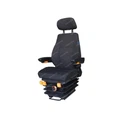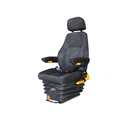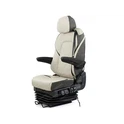


Some people say that a driver seat with ventilation and heating functions is a good seat safety truck seat ? Let me tell you the answer, absolutely not!
To use an inappropriate analogy, if you can make a good car seat by stacking ventilation, heating, massage and other functions together, does that mean that as long as the right raw materials are provided, everyone can become a good chef? Woolen cloth?
Obviously, there are not that many good chefs in the world, and not all car seats with full functions can make you feel comfortable while sitting on them.
What do you need to consider for a so-called good truck driver seat?
What factors need to be taken into consideration when designing a freightliner truck seats?
Before talking about specific design factors, let me first talk about a general rule in the design circle: all parts related to modeling surface design are the result of a compromise between modeling visual effects and engineering technical feasibility. The focus of today's talk It is not the key points of the shape design, but what factors need to be considered in the driver's seat design from the perspective of engineering realization.
● Structural Feasibility:
Judging from the parts composition of the heavy duty truck seat, it includes the sheet metal parts of the frame, leather covering parts, support foam parts, plastic function buttons, etc. The mold ejection angle needs to be considered. Will it scratch the parts? The size of the rounded corners at the base of the covering. If the rounded corners are too small, will the leather covering be punctured? Also, the parting line and flange position of the plastic buttons, will they cause any irritation when using them? Can the individual parts be assembled together after they come out? These are all categories of structural feasibility.

● Ergonomics:
The driver's seat is not a sofa, it is a component in the car, so the relationship between the seat and surrounding parts needs to be properly considered.
● Collision Safety:
This is actually not difficult to understand. Once a collision occurs, the seat, as the part closest to the driver and passengers, needs to play the first layer of protection. At this point you should be able to realize that the connection between the seat rail and the body is very important.

If the seat back bends under impact, it will definitely cause significant damage to the waist; or if the headrest does not have enough support, the impact on the neck can be imagined. Therefore, the seat should provide appropriate protection to provide strong support in the event of an impact.
● Durability:
This again has to do with the part itself. Among them, it involves the durability of the skeleton, the durability of the foam, the durability of the cover, etc.
The so-called durability, simply put, refers to whether the functions, comfort, etc. of the seat can remain the same as before after long-term use.
Take the durability of foaming as an example. The softness and hardness of the foam is to find a balance between the comfort and support of the seat. It is undoubtedly the best state just after leaving the factory, but if you are a driver or have been sitting for a year and a half, the foaming will If the parts undergo normal deformation (deformation that cannot be restored after removing external force), or you can understand that the foam is flattened, then the comfort and support will no longer exist.
Parts such as the frame that involve strength and hardness require more attention. Once there is a problem with durability, it will definitely affect the safety of passengers.
● Comfort:
In addition to the fabric, what is more important is whether the foamed shape of the seat fits the human body better. For example, if the waist area is always in a suspended state, then this muscle needs to be tightened, and lactic acid will begin to be secreted after a period of time.
In the design, a more intuitive solution is to test the pressure distribution of the seat. The area with greater pressure means that the muscles need to exert more force, and the area with lower pressure means slight contact or even a suspended state. Then engineers need to What it does is to average the pressure on the body, reduce the areas with high pressure, and increase the areas with low pressure, so that the whole body is supported by a certain pressure, but it does not need to be a large range. This can best ensure the body's relaxation.
Behind this, the shape of the foam, the materials used, and the posture of the body are all related to it. Some well-established OEMs will intentionally design seat DNA to control the shape and position of the seat surface, thereby indirectly ensuring the posture of the body. , keeping it in an area where pressure support is dispersed to allow the passenger's body to gain a sense of relaxation.
● Quietness:
In other words, noise control. You must know that there are many parts in the seat assembly, such as headrest, backrest, armrests, legs, etc. Each part is a movable part, and naturally there will be gaps. Once the installation work difference between the parts is not controlled well, there will be This will cause parts to rub against each other during driving, which is the so-called abnormal noise.
In addition, each part also has a natural frequency. When it is close to the motion frequency, the seat will resonate and vibrate, which will undoubtedly affect the riding experience. Therefore, during design, engineers will carefully define tolerances and frequencies and use a large number of experiments to verify them.
Therefore, it is important to choose the correct truck air suspension seats. If you don't know how to choose the right driver truck seat, please contact YSR Seating(China safety truck seat suppliers):